
Three days later her brother’s attorney recorded a notice of pendency with the county auditor, and the deal stalled for seven weeks. That document is a lis pendens, and it damages a Washington sale more severely than a typical lien. It takes something worse: the buyer’s confidence.
I’ve bought houses across Washington for years, and a lis pendens shows up more often than you’d guess, whether from divorce, probate fights, or contract disputes. It works a certain way, and you can genuinely do something about it.
How Does Washington Law Define a Lis Pendens?
A couple in Puyallup called me about an inherited duplex they’d been fighting over with a cousin. Their title company had flagged a filing nobody in the family had mentioned, and suddenly they understood why two buyers had walked.
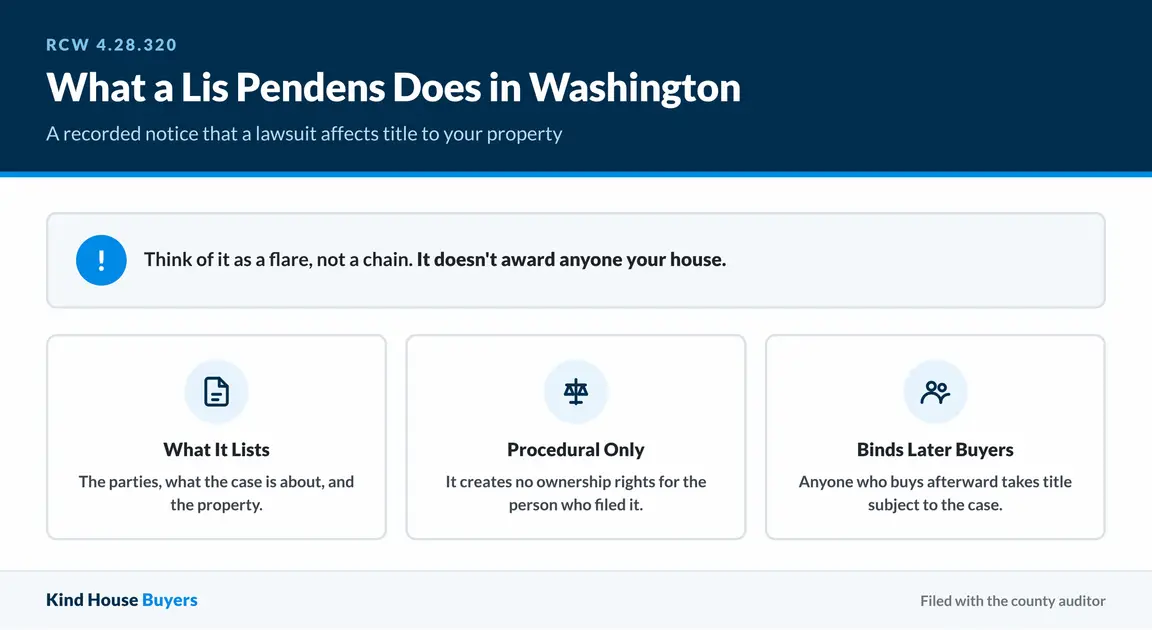
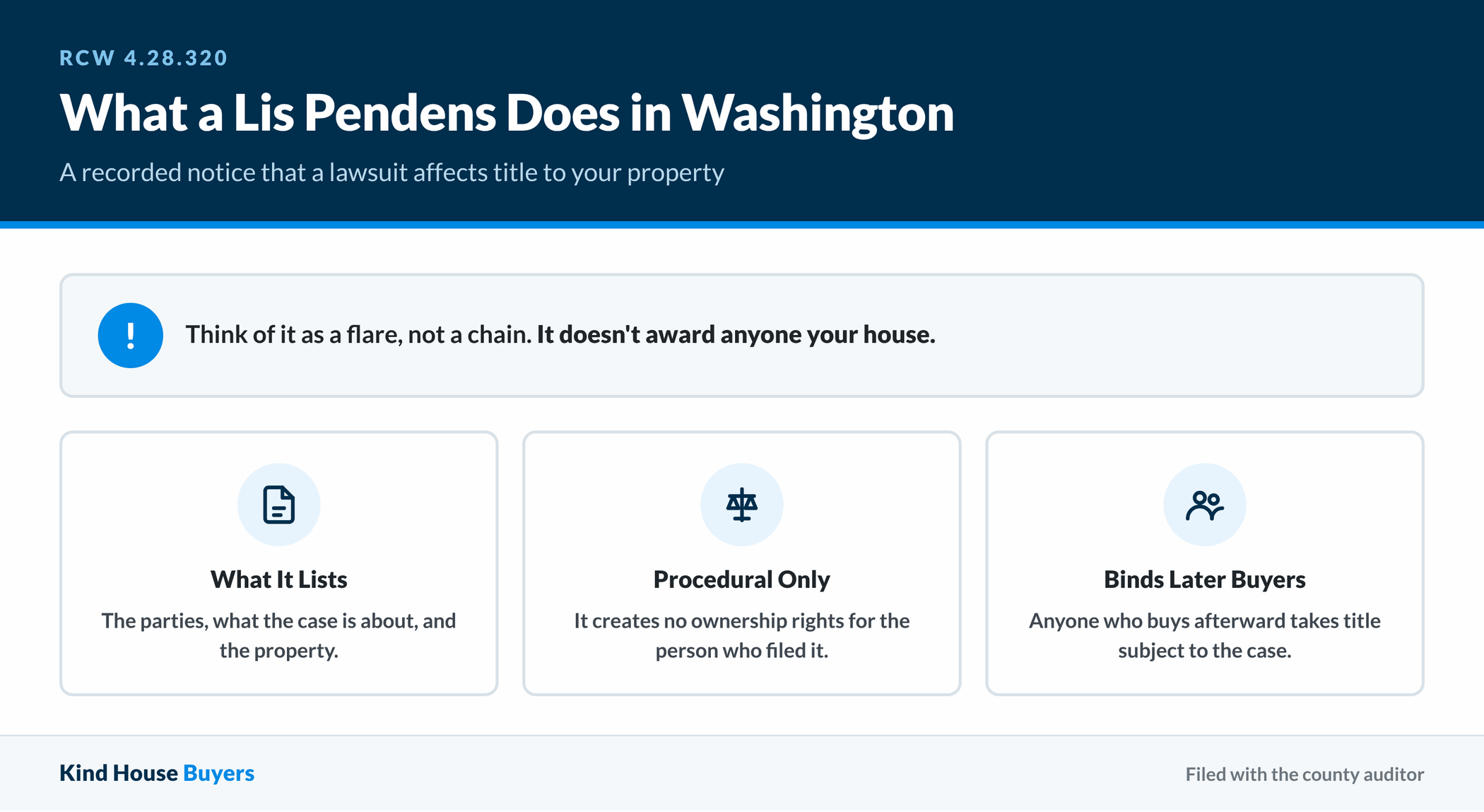
The state’s pending-litigation notice statute lives at RCW 4.28.320. Once an action affecting title to real property has been commenced, the law says that the plaintiff, the defendant, or a court-appointed receiver may file a notice of the pendency of the action with the auditor of each county where the property sits, and that notice identifies the parties, states what the case is about, and describes the property. You can read the full chapter on the Washington Legislature’s site.
Think of it as a flare, not a chain. It doesn’t award anyone your house.
After the notice is recorded, the lawsuit becomes constructive notice to anyone who later buys the land or takes a mortgage or lien against it. Before the filing, a pending suit gives a buyer no such warning. Courts in Washington have described it as a tool that freezes the status of the property in time, because the cloud on title follows any transfer.
One thing worth getting straight: this notice there is procedural. Courts there have said it is procedural only and does not create substantive rights in the person recording it. So the neighbor who files one doesn’t own a slice of your house. He’s just told the world he’s suing over it, and such a filing there makes that announcement permanent in the public record until a court or the claimant clears it.
Who Can File a Lis Pendens on Your Washington Home?
Assume anyone can file one against you and you’ll waste thousands fighting the wrong battle. The filing rights are narrower than that, and knowing the boundary changes your strategy.
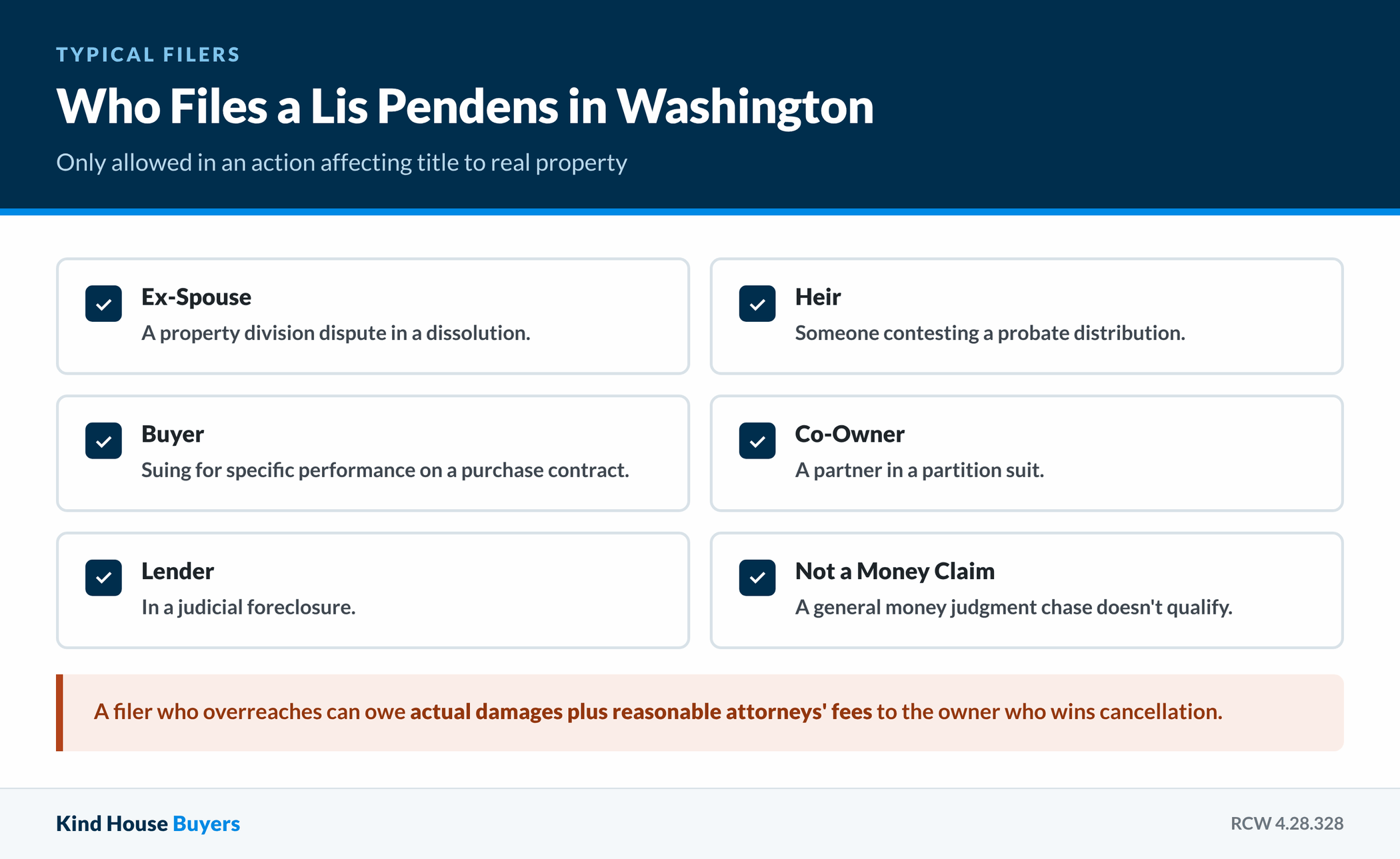
Only in an action affecting title to real property does state law authorize recording a lis pendens. A contractor who’s owed money for a deck has lien rights, but a general money judgment chase isn’t the same animal. Typical filers in Washington include an ex-spouse in a dissolution with a property division dispute, an heir contesting a probate distribution, and a buyer suing for specific performance on a busted purchase contract. They also include a partner in a partition suit and a lender in judicial foreclosure.
Washington backs that limitation with real consequences for filers who overreach. Under RCW 4.28.328, a claimant who files a lis pendens in an action that doesn’t affect title is liable to the aggrieved party who wins a motion to cancel it. Actual damages plus reasonable attorneys’ fees incurred in canceling it are owed by the claimant. A second provision applies too. Unless the claimant shows substantial justification for filing, that claimant is liable to a party who successfully defends the underlying action for actual damages. Fees and costs may be awarded by the court. The statute text is here.
Government filers, including federal agencies and Washington state agencies, political subdivisions, and municipal corporations, are excluded from the claimant definition.
Does that mean a bogus lis pendens pays for itself to remove? Not always, though it has happened. More often the fee award arrives long after your buyer has moved on to a different house in Olympia or Kent, which is why speed matters more than vindication.
When Does a Lis Pendens Attach to a Washington Property Title?
Someone can sue you over your Spokane rental in January and sit on that complaint for months. Until the notice hits the county auditor’s recording index, a buyer purchasing in February takes clean, since the pending lawsuit, standing alone, gives a buyer no notice. That gap is real, and it’s why attorneys record a lis pendens early in Washington litigation.
The filing goes to the auditor in each Washington county where the land sits, so a parcel straddling a county line can carry two notices. King County, Pierce County, Whatcom County: each auditor’s office maintains its own index, and in my experience tracking title work, an examiner in Washington searches by legal description against that index.
Not long ago I worked with a young couple in Burien whose contractor quoted a kitchen remodel that cost more than the kitchen was worth. Midway through weighing that bid they found out a partition suit against the lot had been recorded two months earlier. Their garage was still full of unopened cabinet boxes when they decided to sell instead of renovate.
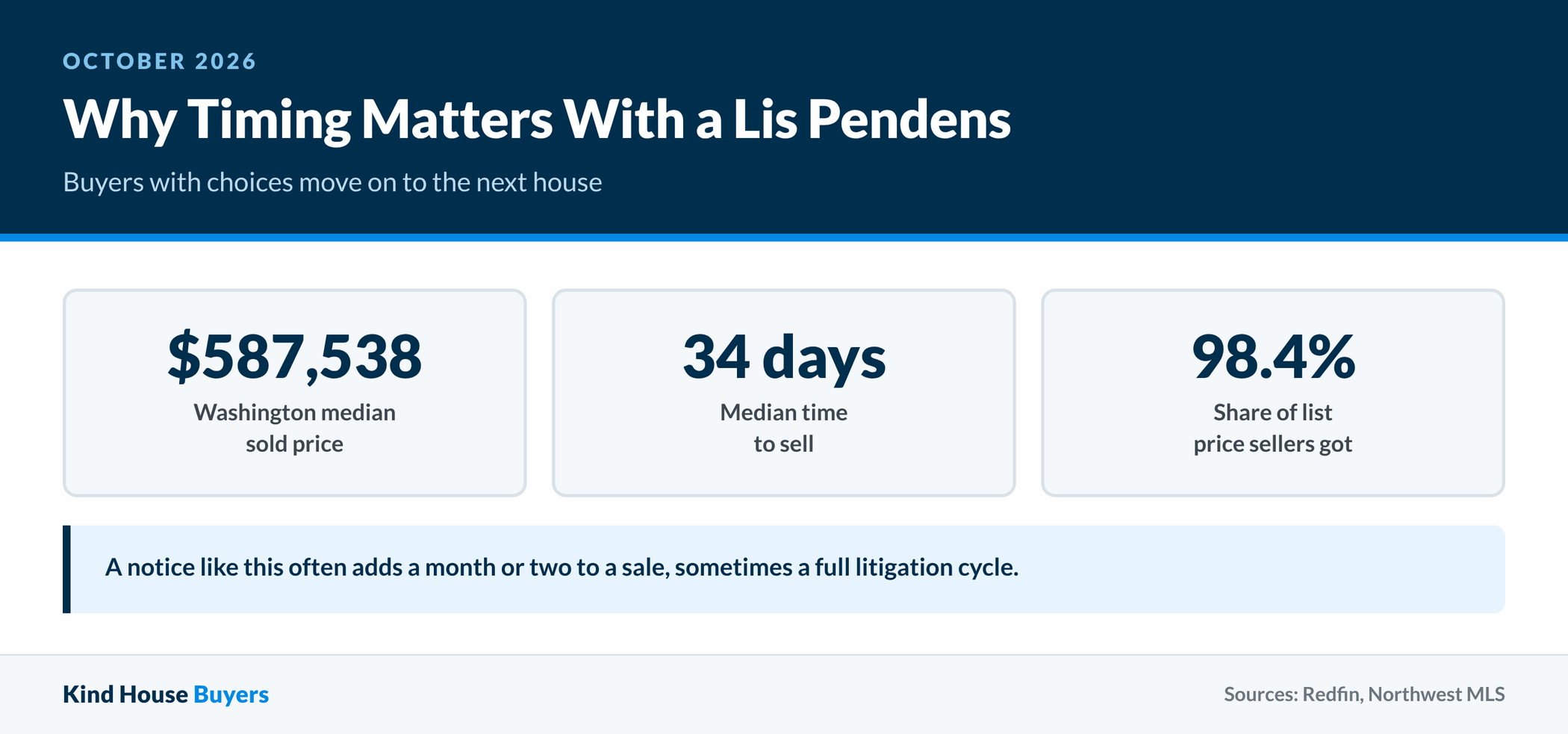
Timing cuts against sellers in a market like this one. Washington’s statewide median sold price was $587,538 in October 2026, down 2.1% year over year according to Redfin, with homes taking a median of 34 days to sell. Add that notice to a 34-day clock and you’re not adding a week. A Washington notice of this kind frequently adds a month or two, sometimes a full litigation cycle, and prices in a softening market don’t wait.
What Does a Lis Pendens Mean for Your Washington Property?
Can I still live here? Yes. Nobody’s taking your keys over a recorded notice.
You keep ownership, you keep possession, you keep paying the mortgage and the Washington property taxes. But any buyer who takes title afterward is bound by all proceedings taken after the filing to the same extent as if he or she were a party to the action. That’s the whole mechanism. A lis pendens doesn’t block the deed; it poisons what the deed is worth.
Refinancing stalls for the same reason. A Washington lender recording a deed of trust behind a lis pendens could find its security interest subordinate to whatever the court eventually decides, so underwriting departments simply decline rather than price that risk.
Your equity position might, depending on what the suit seeks.
Something I keep seeing: sellers treat it as a bookkeeping error and tell their agent to list anyway. Then the title commitment arrives with an exception the buyer’s lender won’t waive, and the listing goes stale, which in my experience draws lowball offers almost every time in Washington. I’d rather a seller spend two weeks resolving it than four months watching a price reduction ladder. When the underlying fight can’t be settled fast, a cash purchaser who can take title subject to the dispute becomes the realistic path, and firms like Kind House Buyers evaluate Washington properties with exactly that kind of cloud.
Does a Washington Lis Pendens Scare Off Buyers and Lenders?
Retail buyers in Washington are often willing to hear the story. Their underwriter isn’t. Conventional lenders typically require a title policy without a pendency exception, and no Washington title company will insure over an active lis pendens without an indemnity, a bond, or a recorded release. The recording tells prospective purchasers that title is subject to dispute and that the record owner’s interest is in question.
Picture a family touring a Vancouver split-level on a Saturday, then reading the words “pending litigation” in the disclosure packet on Sunday.
What that fear costs you depends on market conditions. Washington inventory sat around four months in October 2026, a balanced market by Northwest MLS data, with sellers collecting about 98.4% of list price. Buyers with that many choices don’t negotiate around a Washington lis pendens. They just go look at the next house.
I’ve seen plenty of experienced Washington investors, probate buyers, and 1031 exchangers read these filings routinely and price the risk instead of fleeing it. The discount they apply depends on whether the claim is a long-shot grievance or a credible ownership claim; a weak lis pendens barely moves their number, and a strong one moves it a lot.
Can You Sell a Property with a Lis Pendens in Washington?
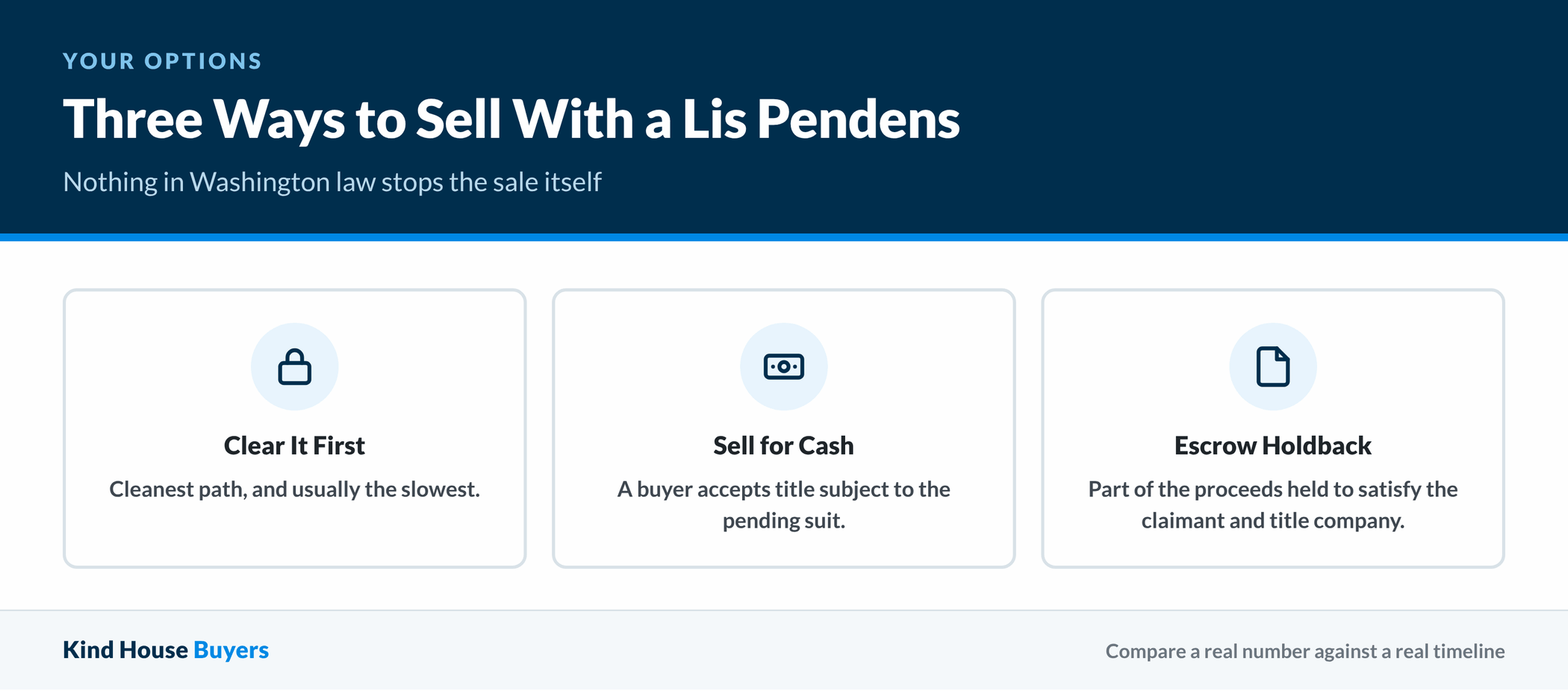
A Bremerton seller had three failed closings over nine months and a mortgage she couldn’t carry. The fourth buyer closed in twelve days because he understood what a lis pendens does and structured around it.
So yes, you can sell. Nothing in Washington law prohibits conveying a property with a lis pendens recorded against it. What the law says is that anyone who acquires an interest afterward takes it subject to the property’s ultimate disposition in the pending suit, so the litigation simply rides along with the new owner.
Three realistic paths exist in Washington. Clear the lis pendens before closing, which is the cleanest and usually the slowest. Sell to a cash buyer who’ll accept title subject to the pending suit. Or escrow a portion of proceeds under an agreement that satisfies the claimant and the title company.
Most people wouldn’t, which is why the buyer pool shrinks to those who can absorb that outcome.
A property doesn’t just lose a little value when a cloud like this shows up, it trades at a real discount. A Washington property carrying a disputed ownership claim typically trades below what a clean-title comparable fetches, and anyone promising full retail with it still unresolved is selling you a story. I’d tell a seller in Everett or Yakima the same thing: get a real number for selling now, get a real timeline for clearing it. Compare the two with a calculator rather than hope.
What Happens If You Sell Despite an Active Lis Pendens in Washington?
In Washington sellers complete a disclosure statement, and concealing known litigation invites exactly the kind of claim you were trying to escape. Disclose the lis pendens, disclose the case number, hand over the complaint. A buyer who signs with full knowledge has far less room to come back at you.
If the plaintiff wins and the judgment affects ownership, that outcome binds the new Washington owner the same as it would have bound you. Most purchase agreements in these situations include indemnity language, a price reduction, or a holdback in escrow until the suit resolves.
Title insurance is the practical gatekeeper. A Washington title company will typically issue a policy with a specific exception carving out the lis pendens claim, which means the buyer has coverage for everything except the one thing that matters.
Your mortgage doesn’t disappear either. Proceeds pay off your Washington lender at closing regardless of the litigation, assuming there’s enough equity.
Our team has taken Washington properties with recorded pendency notices when the seller needed out and the dispute was going to drag for a year. The offer was lower than a clean sale, and the seller knew why, and she took it because carrying costs were eating her faster than the discount did.
What Steps Clear a Lis Pendens Before Closing in Washington?
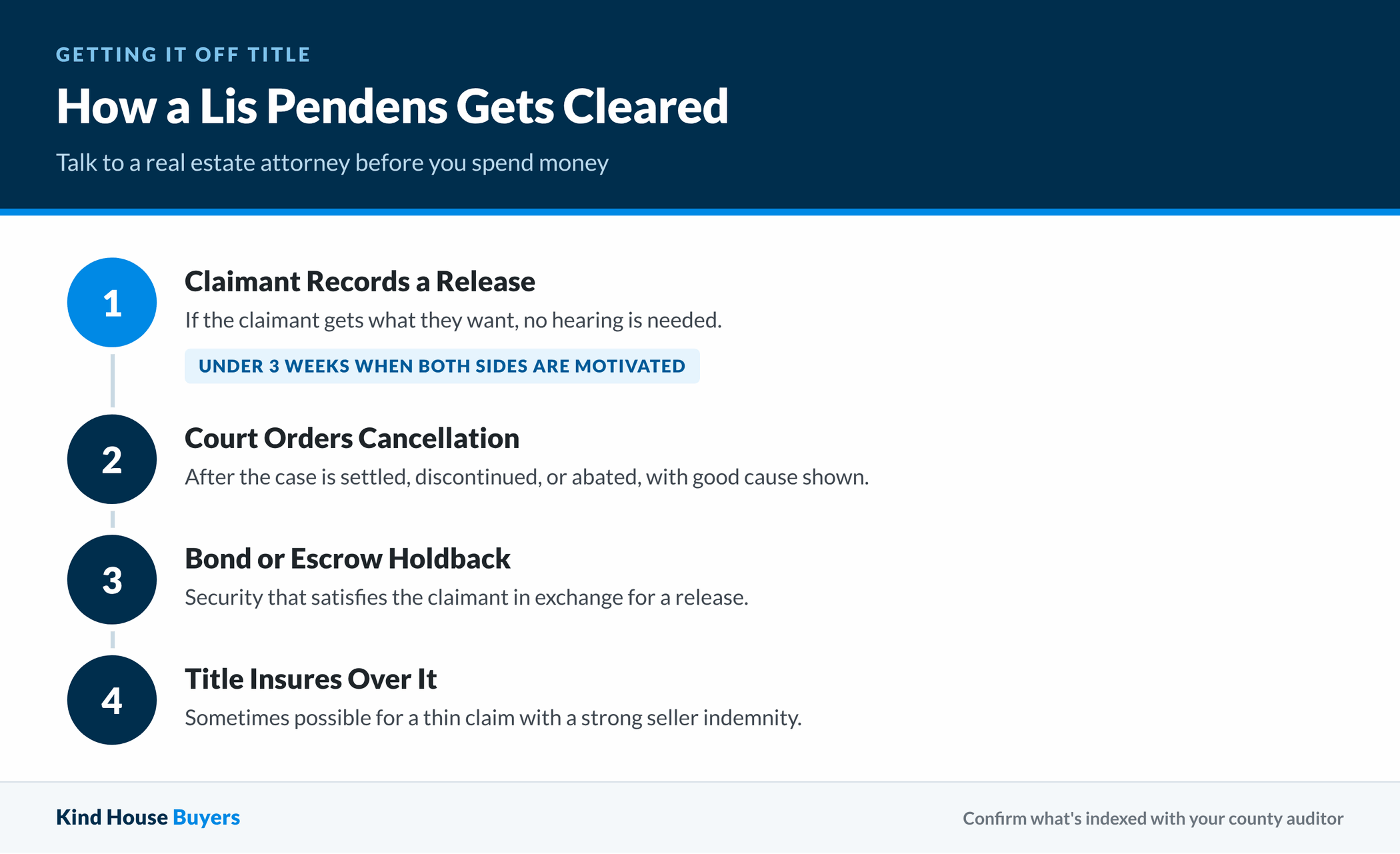
Which brings us to the version of this problem everyone actually wants: getting the thing off the title.
When the plaintiff gets what they’re after, their attorney records a release and the Washington lis pendens comes off without a hearing. I’ve watched this happen in under three weeks when both sides were motivated.
Court cancellation is the other door. The court where the action was commenced may, at its discretion, at any time after the action has been settled, discontinued, or abated, order the notice canceled of record by the county auditor. This requires an application of an aggrieved person and a showing of good cause. The cancellation is evidenced by recording the court order. Washington appellate courts have treated that “settled, discontinued, or abated” language seriously, so an active, contested case is hard to cancel on those grounds alone.
Pair it with a fee request under the liability statute and you’ve given the claimant a reason to negotiate.
Some Washington cases resolve with a bond or an escrow holdback that satisfies the claimant’s security concern, and the notice gets released in exchange. Title companies will sometimes insure over a thin claim with an indemnity from a financially solid seller, though they’re cautious about it.
Get a real estate attorney involved before you spend money on any of this. Your county auditor’s recording office can confirm what’s actually indexed against your parcel, and the Washington Courts site can point you toward the superior court handling the case.
A landlord up in Mount Vernon reached out after four years of chasing rent on a house he’d inherited and never wanted to manage. A tenant dispute had turned into litigation with a lis pendens attached, and the back deck was rotting. He told me on a Thursday that he’d rather take less money than spend one more weekend at that property. We closed, and he sounded relieved in a way that had nothing to do with the number.
Frequently Asked Questions About a Lis Pendens in Washington
What Is a Lis Pendens in Real Estate?
It’s a recorded notice telling the world that a lawsuit affecting ownership of a specific property is pending. In Washington, it gets filed with the county auditor where the land sits, and it describes the parties, the object of the suit, and the property itself. The notice doesn’t transfer anything or create a lien; it just warns future buyers and lenders that they’ll be bound by whatever the court decides.
How Long Does a Lis Pendens Last in Washington?
There’s no automatic expiration date in Washington. A lis pendens stays on the title until the underlying case resolves and someone records either a release from the claimant or a court order canceling it. A straightforward dispute might clear in a month or two; a contested probate or partition case can run well over a year, and the notice sits there the entire time.
Can I Refinance a Washington Property with a Lis Pendens on It?
Realistically, no. Lenders need a title policy without that exception, and a Washington title company won’t issue one while the claim is live. Your better moves are resolving the dispute, posting security the claimant accepts, or selling the property outright if the carrying costs are the real pressure.
Does Selling Make the Lawsuit Go Away for Me?
Not by itself. Transferring the property doesn’t remove you as a defendant, and the claimant can keep pursuing claims against you personally depending on what they’re suing over. Selling ends your carrying costs and your exposure as the record owner, but talk to an attorney about what remains before you assume the sale closes the whole chapter.
Will a Buyer Pay Market Value for a Washington House with a Lis Pendens?
Usually not full retail. The pool of buyers shrinks to people who can close without conventional financing and who understand the risk they’re taking on, and that shortage shows up in the price. How steep the discount runs depends on how credible the underlying claim looks and how long the case is likely to drag.
Who Pays to Remove a Lis Pendens in Washington?
Typically the property owner fronts the attorney costs to fight it. If you win and the court finds the filing wasn’t justified, Washington law lets you recover actual damages and fees from the claimant, though collecting is a separate project from winning. Factor that lag into your decision rather than counting on reimbursement to fund the fight.
If you’re sitting with a lis pendens on your Washington property and you’re not sure whether to fight it, wait it out, or sell, I’m happy to walk through the math with you. No pressure, no obligation, and if the right answer is hiring an attorney instead of selling, I’ll tell you that too.
Selling a House Under a Cloud in Pierce County
Pierce County is still a seller’s market on paper, with about 2.8 months of inventory in the second quarter of 2026. A house with a lis pendens doesn’t get that advantage, because most financed buyers can’t close on it. That gap is why sellers here often weigh a direct sale while the case plays out.
Talk With Kind House Buyers About Your Options
If a lis pendens is holding up your Washington sale, reach out to Kind House Buyers and we’ll go over your options with you. You can also fill out the form below for a no-obligation cash offer.