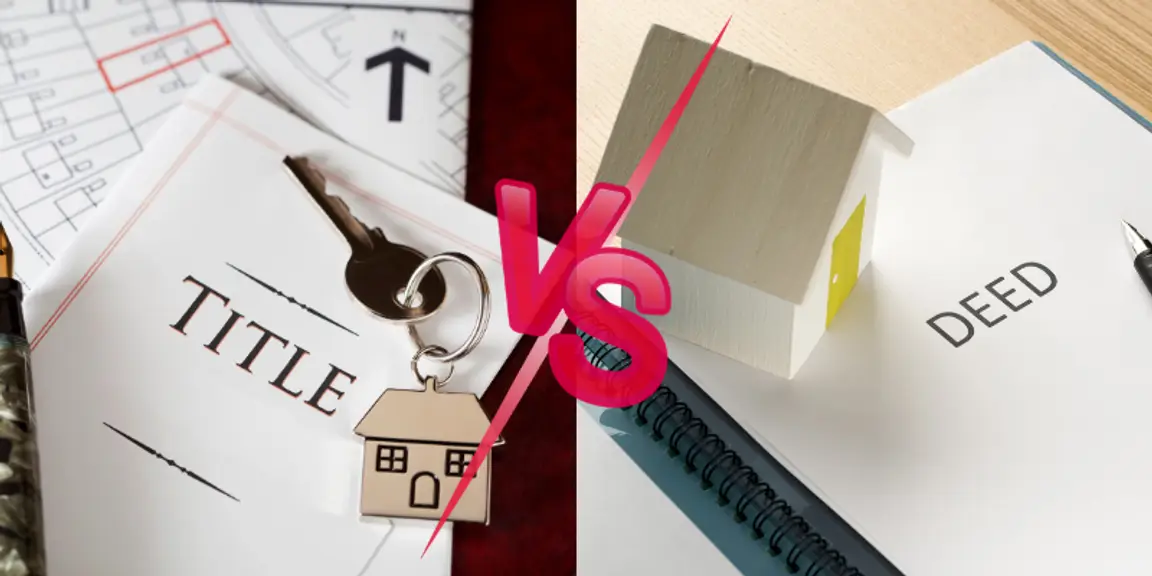


Most homeowners sign a deed and receive a title policy at the same closing table, hand back a stack of paper, and walk out with a set of keys. To them the two feel like one thing. They aren’t. The difference between title and deed is worth understanding, because mixing them up creates real headaches later, when you’re trying to sell, refinance, or settle an estate.
The Concepts Most People Confuse From Day One
A deed and a title do different jobs, and they aren’t the same document. Treating them as interchangeable is the misunderstanding I run into most often with homeowners getting ready to sell. Your deed is a physical document. Somebody put a pen to it, a notary stamped it, and the county recorder filed it away. Title is a legal concept instead, the bundle of ownership rights that either sits cleanly with you or doesn’t. You can hold a deed and still have a title problem. The reverse happens too, where your title is clear but the old deed needs redrafting because of a typo in the legal description.
According to the National Association of Realtors, the median existing-home sale price hit $434,100 in July 2026. At that kind of money, a clouded title or a deed recorded in the wrong name will stall a sale, and no amount of staging fixes it. Sellers usually find out late. I’ve watched it surface the morning of closing, and then everyone’s scrambling. Sorting this out early is worth your time. If you would rather not carry that risk through a listing, here is how we buy houses, title snags and all.
What Is a Property Title?

A skeptical seller might say, “I’ve paid the mortgage for twelve years. Of course, I own the place.” Fair enough. Legal ownership and financial obligation are still two different things. Your name on the mortgage note means you owe a bank money. Your name on the title means you hold the ownership rights. Usually, the name and the rights line up. Divorces and estate transfers are where I’ve seen the gap open, and it surprises everyone involved.
A real estate title covers the full set of ownership rights attached to a property. Those rights let you use the land, sell it, lease it, pass it to your heirs, and keep everyone else off it. Ownership interests are split in many ways. One person can hold them alone, two spouses can share them, or several heirs can each own a share, sometimes an unequal one.
The title is also what title insurance protects. There are two kinds of title insurance policies. A lender’s title policy protects the bank’s own financial interest, and your lender requires that policy whether or not you buy anything for yourself. The optional homeowner’s title insurance policy is the one that protects you. Combined, the two typically run between 0.5% and 1% of the purchase price. Fold in the related settlement services and the median lands near 0.67% of the purchase price, according to Fannie Mae figures the American Land Title Association publishes. You pay once, at closing. It isn’t an annual premium, which is easy to forget in the paperwork.
So the title is the ownership right, and the policy is the protection you buy for it.
What Is a House Deed?
A couple in Pierce County came to us with a deed listing one spouse’s name, recorded years before they married. Both believed the home was theirs jointly. Their estate plan said so. Nobody had ever updated the deed itself. The title company caught it before closing, the fix took three weeks, and it cost money neither of them had budgeted for. I see that pattern more than most people would guess. It turns up regularly with owners who want to sell a house fast in Puyallup, where an old deed and a newer marriage often disagree.
Your property deed is the signed document that transfers legal ownership from one party to another. It names the grantor, meaning the seller, and the grantee, meaning the buyer. It carries a legal description of the property and is recorded with the county. Recording is what makes the transfer public. Without it, no transfer officially happened, whatever a private contract between the two of you says.
Warranty deeds, quitclaim deeds, and grant deeds all show up in ordinary transactions, and the deed type you accept changes what you can do about a problem later. General warranty deeds give the highest level of protection. Limited warranty deeds narrow the seller’s warranties down to their years of ownership. Quitclaim deeds carry no warranties whatsoever, which is fine in the right setting, like a spouse signing their interest out of a house during a divorce. Taking a quitclaim deed from a stranger in an arm’s-length sale is asking for trouble, because you’d have no recourse when something surfaces later. I’ve watched buyers learn that after closing.
Deed vs. Title: What Is the Difference?
Most articles about deeds skip the part that actually bites. A deed can be executed perfectly, signed, notarized, and recorded, and the title underneath it can still be defective. Picture a seller who received the property through a deed that a previous owner forged twenty years ago. The county recorded it. Nobody caught it. That title was never clean, and the problem rides along through every later transfer until somebody digs it up.
The two compare like this.
| Deed | Title | |
|---|---|---|
| What it is | A signed, notarized paper document | A legal concept, the bundle of ownership rights |
| What it does | Transfers ownership from grantor to grantee | Establishes who can use, sell, lease, and pass on the property. |
| Where it lives | Recorded at the county recorder’s office | Nowhere physical. It’s a status confirmed by the public record. |
| Time frame | A single moment of transfer | A continuous condition that carries forward |
| How it fails | Typos, missing signatures, and wrong legal description. | Liens, judgments, forgery in the chain, competing heirs. |
| How it’s protected | Drafted by an attorney or title company, then recorded | An owner’s title insurance policy |
A deed is the instrument of transfer. Title is the legal status of ownership. One is a moment, the other a condition that keeps running. Every deed that ever conveyed a property adds a link to the chain of title, the documented history of every ownership transfer going back to the original grant.
Full title examinations read deeds, mortgages, tax records, court judgments, and anything else that could affect the property’s title. They usually cover a period of 30 to 60 years. Inherited properties with messy estates sometimes push the search back further.
Do you know how many owners your property has had? Most sellers don’t, and that’s fine. The title search exists for exactly that reason.
What Does a Title Search Reveal?
Short answer, anything that was ever recorded against it. Title companies pull every document tied to your property, and the list can run back decades.
A title search reviews public records to confirm who legally owns a property and whether the seller can transfer it. What commonly turns up:
- Liens, including a contractor’s lien from a job that wasn’t paid six years ago
- Unpaid property taxes or an IRS tax lien attached to a previous owner
- Court judgments that were never satisfied
- Easements, such as utility company access through your backyard (I’ve seen this kill deals at the last minute)
- Ownership gaps in the chain of title, often from an unresolved estate
- Recording errors in a prior deed, like a misspelled name or a bad legal description
An unrecorded lien is a claim against the property that never made it into the public record, and that’s exactly where an owner’s title insurance policy earns its cost. If something slips past the search and surfaces years later, the insurance company handles it.
Liens get paid in a set order. Property tax liens take automatic priority in nearly every state, and recorded liens fall in line behind them by recording date. Priority is not a technicality. It decides who gets paid out of the sale proceeds first, and a junior lienholder can walk away with nothing. Title companies spend real hours untangling these issues, so a messy lien history can push your closing back by weeks. Skipping the search to save a few hundred dollars is the shortcut that costs sellers thousands at the closing table.
How Do Deeds and Titles Work During a Home Sale?

Sitting at your kitchen table, trying to work out how to sell, what I’d tell you is this. The deed is what you sign to hand over ownership. Title is what the buyer’s side spends weeks verifying before they’ll let that signing happen.
The median home spent 57 days on the market in July 2026, according to Realtor.com, and that number only covers the listing period. Add the contract-to-close window, the title search, and lender underwriting, and the real timeline stretches well past it. Sellers who hit a title problem mid-contract often watch their buyer walk rather than wait for a resolution.
After you sign a contract, the title company or a real estate attorney runs the search. In Washington, that work almost always goes to a title and escrow company instead of an attorney, a different setup from much of the East Coast. Anything the title work turns up, a seller has to clear before closing. That could mean paying off an old lien, getting a court to vacate a judgment, or filing a corrective deed. Each one takes time. Some take money you weren’t planning to spend, and your closing date slides back by weeks.
For a seller, a clear title is what makes the transfer possible. Lenders need the title search for a different reason: to secure their interest in the property as collateral. Both sides of the transaction are leaning on the same paperwork.
Working directly with a buyer like Kind House Buyers skips some of that friction. We handle the due diligence on our end, and we can often work through title complications that would stall a traditional listing. You can look at how it works before committing to anything.
Who Holds the Deed and Title After Closing?
When a transaction closes, the deed transfers to the buyer and gets recorded in the county records. That buyer is now the owner of record.
Something that surprises people: your original deed isn’t sitting in a filing cabinet at your house, and your lender isn’t holding it either. The county recorder’s office keeps the official recorded copy, and that’s the one with legal weight. Ask the recorder’s office for a certified copy any time you need one. Around Tacoma, that is the Pierce County Auditor’s Recorded Documents Office.
If you borrowed to buy the place, the lender records a mortgage or deed of trust against the property, creating a lien that stays until the loan is paid off. Washington is a deed of trust state. A neutral third party called a trustee holds that security interest until you pay the loan, then records a deed of reconveyance. State law gives the lender 60 days after payoff to ask for that reconveyance, and if it stalls, an escrow agent or attorney can step in and get it done. The lien sits in the record right alongside your deed. So the buyer holds title and every right that comes with it, encumbered by the loan, until the balance reaches zero and the lender files a release. A lender’s title insurance policy protects the bank for the life of that loan, while an owner’s title insurance policy covers the homeowner from closing day forward.
An owner’s title insurance policy works differently from most insurance you’ll ever buy. One payment at closing, and that policy covers you for as long as you own the home, including the heirs who inherit the property. That’s cheap protection on the most valuable thing you own.
We work through these exact mechanics on every transaction. If you have questions about how title transfers work in your specific situation, contact us, and we’ll walk you through it.
What Happens When There Are Title or Deed Problems?

Title and deed problems rarely announce themselves before you list.
A couple in Thurston County called us with an auction date already on the calendar. They were three months behind on the mortgage. Working through their paperwork, we found a mechanic’s lien attached to the property from a roofing job the previous owner never paid for. That lien had been sitting in the public record for years, unnoticed, and it had to be resolved before any transfer could happen. Situations like theirs come up more often than sellers expect, and it helps to have a buyer who has handled them before. As cash home buyers in Olympia and the rest of Thurston County, we work through liens like that one all the time.
Liens, unpaid taxes, judgments, easements, and ownership gaps are the title problems that surface most. A deed problem is usually simpler, like a misspelled name, an incorrect legal description, or a co-owner who never signed. Either category can shut a sale down completely.
Sellers with title or deed complications sometimes assume they can’t sell. That’s usually wrong. The complications need to be disclosed and addressed, but they’re rarely fatal to a sale. Experienced cash home buyers have worked through tangled title situations before and won’t immediately walk when something comes up.
Frequently Asked Questions
Does a House Have Both a Deed and a Title?
Yes, every property has both. The deed is the physical document used to transfer ownership, and it’s recorded in the county’s public records. The title is the legal status that confirms your ownership rights. They work together, since the recorded deed is part of what establishes that the title is yours.
Can You Be on the Title but Not on the Deed?
It happens, usually when ownership rights arrive through a court order, an inheritance, or a trust arrangement that never went through a standard deed transfer. Generally, though, the recorded deed is the primary document that establishes title. Most discrepancies between deed and title records need correcting before a sale can proceed.
Does a Deed Mean You Own the House?
A recorded deed in your name is strong evidence of ownership, though it doesn’t guarantee a clean title. A forged deed earlier in the chain, liens attached before you took ownership, or competing ownership claims from an unresolved estate, and any of those can cloud your title while your own deed stays perfectly valid. Those are the gaps that a title search and an owner’s title insurance policy exist to close.
Can Someone Sell a House If Your Name Is on the Deed?
Not the whole house. Everyone named on the deed has to consent to and sign a transfer of the entire property, and a sale attempted without your signature can be challenged and reversed. A co-owner may still be able to sell their own undivided share, depending on how ownership is held and what state you’re in, but that’s a very different transaction from selling the property outright. If you’re in a shared-ownership situation and worried about your rights, your county recorder’s office can confirm who is listed on the recorded deed.
If your situation involves title complications, a deed that needs updating, or you’re just trying to understand what you’re working with before you sell, we’re happy to talk it through. Reach out to Kind House Buyers whenever you’re ready. There’s no pressure and no obligation, just a straight conversation about your options.