
The envelope came on a Tuesday. Inside was a court filing fee receipt, a letter from a legal newspaper, and an invoice from an attorney who’d billed four hours to read a will. They hadn’t sold anything yet, so they were already out of pocket while the house in Spokane still had the deceased’s winter coats hanging by the door. I’ve bought a lot of inherited houses around this state, and the first thing families ask me is what probate cost will do to their net proceeds. Fair question. The answer in Washington is friendlier than in most states, but it’s not free, and the biggest expense is usually one nobody puts on a spreadsheet.
How Much Does Probate Cost in Washington?
“If my mom’s house is worth six hundred grand, does the court take a percentage?”
No. Washington doesn’t work that way, and that single fact saves families here real money compared to states like California. Under RCW 11.48.210, both the personal representative and the estate’s attorney get paid what the court considers just and reasonable, with no statutory fee schedule and no percentage for probate representation. The bill tracks hours worked, not the size of the estate. Probate cost on a modest Yakima rambler and a waterfront place in Gig Harbor can therefore land in the same neighborhood.
Opening the case is the cheap part. The court filing fee runs $290, built from a $200 base under RCW 36.18.020 plus two surcharges set by the same statute. It’s a one-time payment filed in Superior Court in the county where the decedent lived.
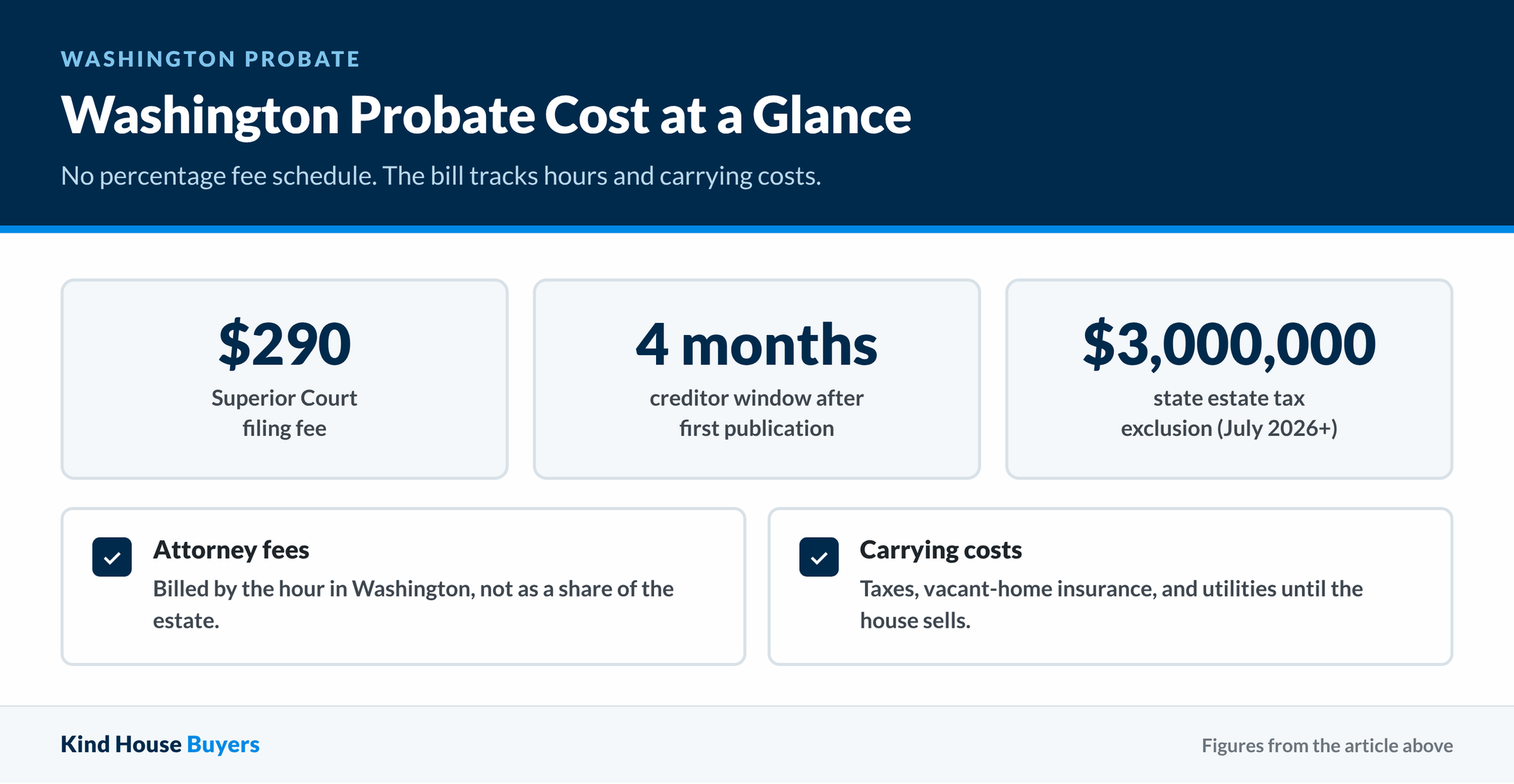
Attorney fees do most of the damage to the total probate cost. For an uncontested nonintervention estate, typical attorney fees run between $3,500 and $7,500, and hourly rates across Washington generally sit in the $250 to $400 range. Add publication of the notice to creditors, certified copies, and a few recording fees, and most straightforward Washington probates I’ve seen close out somewhere in the low five figures.
Here’s where I’d push back on the usual advice. Lawyers and estate-planning sites love quoting probate cost as a percentage of the estate, but that’s not really how it works here. That framing is imported from other states, and it inflates what families brace for. Your probate cost depends on how messy the paperwork is, not how much the house appraises for.
Washington Probate Fees: Court Costs, Attorney Fees, and More
A family carries much of its probate cost in Washington in ways that never show up on a court invoice.
Carrying costs are the line item that eats estates alive. Property taxes keep coming. Insurance on a vacant house costs more than a standard homeowner policy, assuming your insurer will even write it, and plenty won’t after a few months of nobody living there. Utilities have to stay on so the pipes don’t freeze during a February cold snap east of the Cascades. Lawn care, gutter cleaning, someone driving by to check the doors.
Publication of the probate notice to creditors is a small, unavoidable expense. Under RCW 11.40.020, that notice gets filed with the court and published once a week for three successive weeks in a legal newspaper. Different counties use different papers, so the price varies, and your county clerk’s office can tell you which publication qualifies.
A couple of years ago I got a call from a longtime landlord in Puyallup who’d inherited his father’s duplex and fallen three months behind on the mortgage while the estate sorted itself out. The auction date was already on the calendar, and the garage was stacked to the rafters with tenant furniture from three different move-outs. We closed before the sale date, and the probate cost that had been quietly stacking up stopped stacking.
Personal representative compensation is its own conversation. Washington personal representative fees often land somewhere around 1% to 3% of estate value, though that varies widely, and family members serving in the role frequently waive it entirely. My opinion: if you’re the sibling doing all the work, you should take the fee. Resentment costs more than money.
Appraisals, estate tax preparation, and an accountant for the final income tax return round out the list. None are huge individually. Together they’re why the real probate cost in Washington usually beats the court’s filing fee by a factor of twenty or more.
What Drives Up Probate Costs in Washington
You might be thinking none of this applies because your family gets along fine, which is genuinely the best predictor of a cheap probate, and I’d never talk you out of it. Getting along isn’t the only cost driver, though, and the others sneak up quietly.
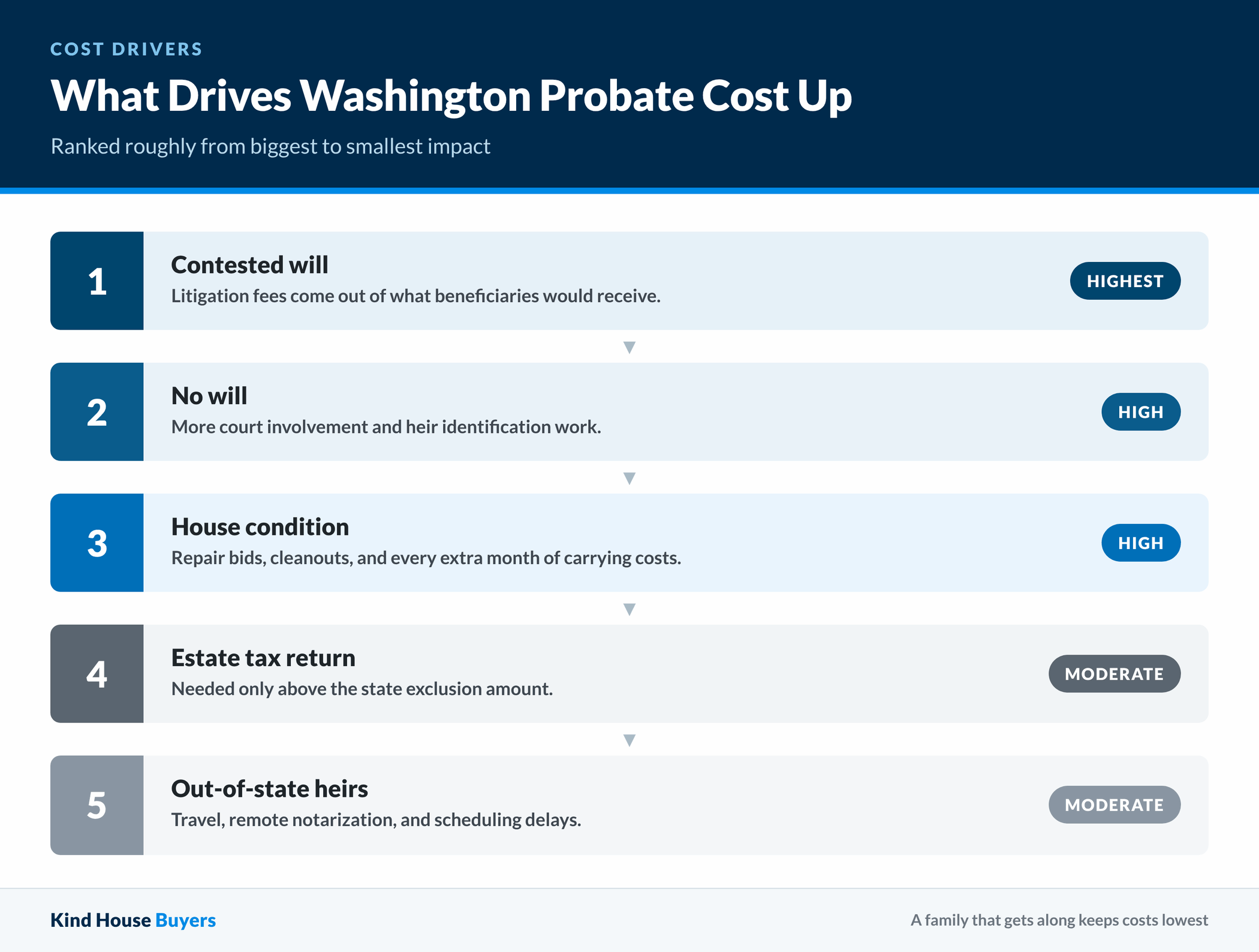
Dying without a will is the big one. Intestate estates follow Washington’s intestate succession rules, which means more court involvement, more heir identification work, and more attorney hours. Add a half-sibling nobody’s spoken to since the nineties and your probate cost climbs by thousands.
Contested wills are the nuclear option. Under RCW 11.96A.150, a Washington court may award costs and reasonable attorney fees to any party, payable by another party, out of the estate or trust assets. Litigation fees come straight out of what the beneficiaries would have received.
Then there’s real property condition. A house in Everett with a failing roof and thirty years of accumulation is going to generate repair bids, cleanout invoices, and carrying costs for every extra month it sits.
Most families end up owing nothing in Washington estate tax, though the threshold here sits lower than the federal one. For decedents passing on or after July 1, 2026, the Washington Department of Revenue lists the applicable exclusion amount at $3,000,000, with tax rates running from 10% to 20%. The federal exemption sits at $15 million per person in 2026. That gap is why a Mercer Island or Medina estate can owe tax to Olympia while owing nothing to the IRS, and estate tax return preparation adds to probate cost all on its own.
Out-of-state heirs drive up probate cost too. Travel, remote notarization, mailed signatures, scheduling conflicts across time zones. Each delay is another month of insurance and taxes on a house nobody’s living in.
Does Property Affect Probate Costs in Washington?
Families picture the house as the asset that pays for everything. Then they discover the estate has almost no liquid assets, the mortgage is still due the first of every month, and the court filing fee has to come out of somebody’s personal checking account. Real property doesn’t fund probate. It consumes probate funding until the day it sells.
Washington’s market makes that math sharper than it used to be. In October 2026, the median price for homes and condos sold through the Northwest Multiple Listing Service was $620,000, down 3.1 percent from a year earlier, with inventory at 4.41 months. More inventory means buyers take their time. Stretch that across a probate that can’t close until the creditor period runs, and the estate pays to hold a house as prices drift.
County variation matters here. Vancouver and Bellevue sit in very different price brackets, and the NWMLS county tables show that gap every month. Pricing an inherited Vancouver house like a Bellevue house is how listings go stale.
Title issues are a quiet multiplier on probate cost. An old deed with a deceased co-owner still on it, a boundary question with the neighbor, an unreleased lien from a contractor in 2009. Each one needs legal work before any buyer can close.
Something I keep seeing: families spend money fixing up a house that a buyer is going to renovate anyway. New carpet in a home that needs a new roof is money set on fire. I’d rather see that cash stay in the estate.
One more wrinkle specific to Washington. The small-estate affidavit route under RCW 11.62.010 covers personal property only, with a $100,000 threshold and a 40-day wait. A house doesn’t qualify. Owning real property in Washington generally means a full probate, and the probate cost that comes with it.
How to Lower Probate Costs in Washington
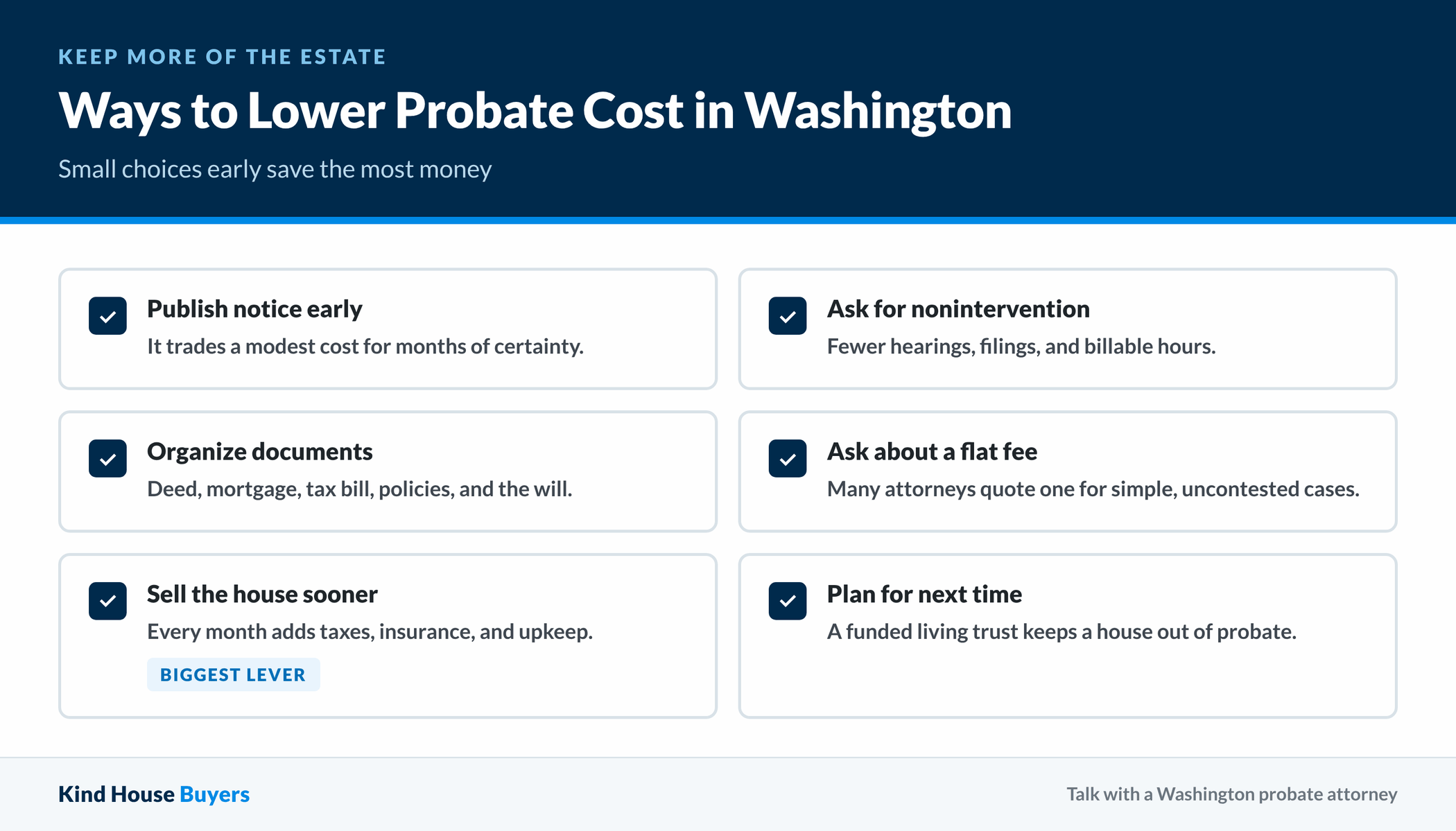
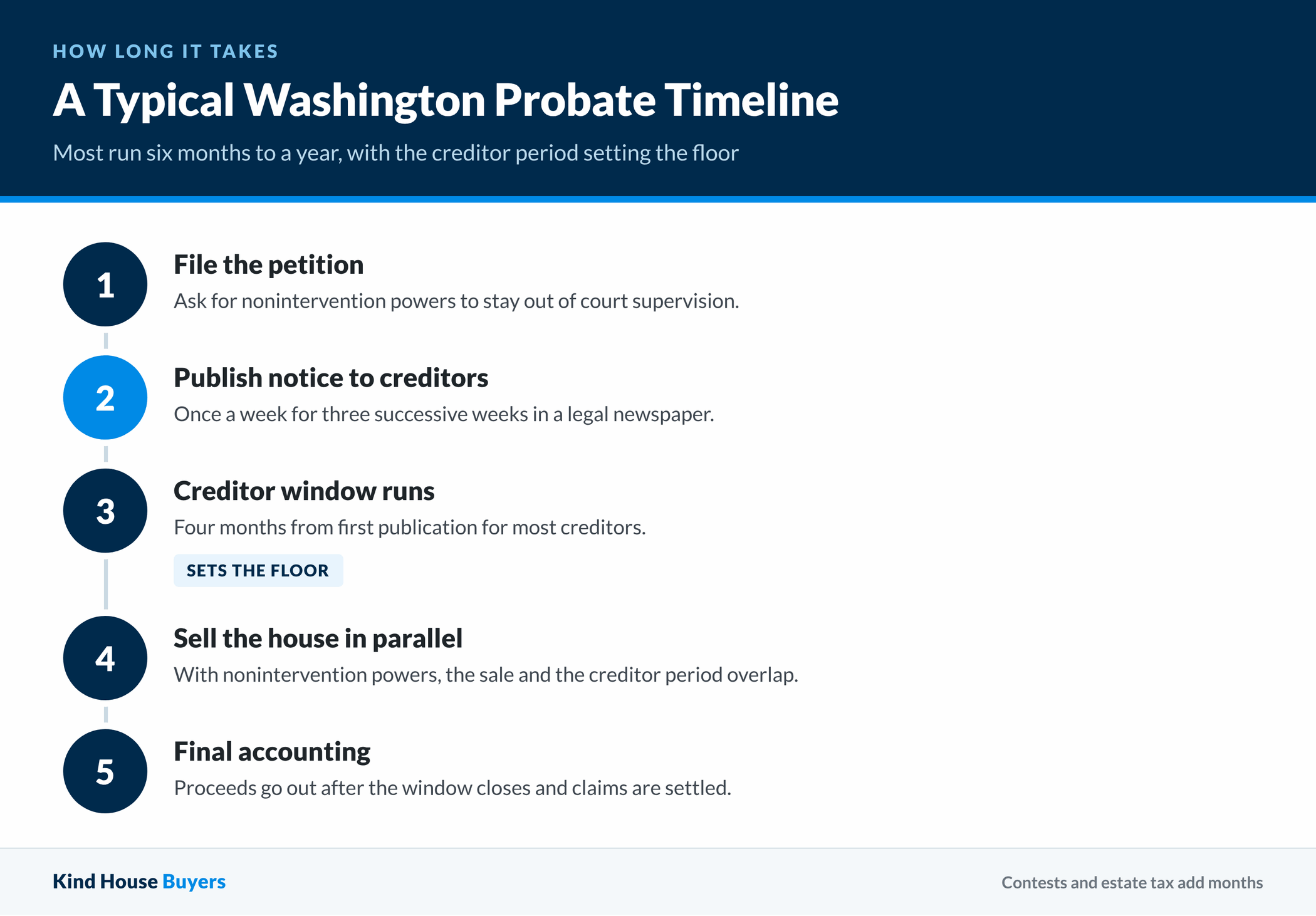
Can anything actually be done to shrink that creditor window? Publishing the notice to creditors early is the single most useful thing a Washington personal representative can do, and it’s the cheapest insurance you’ll buy in the whole process. Under RCW 11.40.051, a creditor who gets published notice generally has four months from the date of first publication to present a claim or be barred. Skip the notice and a creditor can have up to twenty-four months after the date of death. Publishing trades a modest cost for twenty months of certainty.
Ask your attorney for nonintervention powers in the initial petition for probate. Nonintervention powers under RCW 11.68 keep most Washington administrations out of court supervision, which cuts hearings, filings, and billable hours.
Get organized before the first attorney meeting. Deed, mortgage statement, tax bill, insurance policy, account statements, the will itself. Every hour your lawyer spends chasing documents is an hour of probate cost you’re funding.
Flat fees beat hourly billing for simple estates. Ask. Plenty of Washington probate attorneys will quote one for an uncontested nonintervention case.
Selling the house faster is the lever with the most leverage. Every month of ownership adds taxes, insurance, utilities, and maintenance to the probate cost total. This is part of why some families in Tacoma and Bremerton choose a direct sale once they have letters testamentary in hand. It’s also why we built Kind House Buyers around no repairs, no commission, and a closing timed to the estate’s schedule rather than a buyer’s loan approval.
For the next generation, a funded living trust keeps the house completely out of probate. Won’t help you today. Worth a conversation with your own kids.
How Long Does Probate Take in Washington?
The paragraph already opens with a concrete scenario rather than restating the heading, so no edit is needed.An heir in Walla Walla filed her petition for probate in March and figured she’d have the orchard-view house sold by Memorial Day. She signed closing papers in October.
That’s not unusual, and the four-month creditor window is why. Most Washington probates run six months to a year, with the creditor claim period setting the floor. Simple estates with cooperative heirs can wrap faster, but a personal representative who distributes before that window closes takes on personal exposure.
Can you sell the house during probate? Yes, in most Washington estates with nonintervention powers, and families do it constantly, since the sale and the creditor period just run in parallel. What you usually can’t do is hand out the proceeds early.
Timelines stretch when the will gets contested, when the estate owes tax, or when an asset is hard to value. A closely held business, mineral rights, a share of a family cabin on Hood Canal. Each one adds months, and months add probate cost.
My honest take on agent listings during probate: they work fine for clean, updated houses in strong Washington submarkets. Snohomish County, for instance, still draws steady buyers for move-in-ready homes. For a dated house with deferred maintenance and a court deadline, the listing route often just burns calendar.
An heir in Kennewick learned that the slow way. Two agent listings, both expired, zero offers across roughly seven months, and a detached shop full of her uncle’s welding equipment that every showing had to walk past. By the time she called us, the probate cost had grown by two more quarterly tax payments and a vacancy insurance renewal she hadn’t budgeted for.
Common Questions About Probate Costs in Washington
I used to tell sellers a will keeps you out of probate. Wrong, and I corrected it only after watching enough Washington families file anyway.
Do You Have to Go Through Probate in Washington If There’s a Will?
A will doesn’t avoid probate; it tells the court who inherits and who serves as personal representative. If the decedent owned real property in Washington in their own name, the estate almost always goes through Superior Court regardless of how clear the will is. The will makes the process cheaper and faster, not optional. That’s the distinction most families miss until the title company asks for letters testamentary.
Does a Mortgage on the House Change the Probate Cost?
The court’s fees stay the same, but the mortgage adds a monthly carrying cost the estate has to cover. Payments keep coming due after a death, and the lender won’t pause them for the estate to get organized. Call the servicer early, because missed payments pile late fees onto your probate cost and can start a foreclosure clock.
Which Assets Skip Probate in Washington?
Anything with a named beneficiary or a survivorship feature generally passes outside probate: life insurance proceeds, retirement accounts, payable-on-death bank accounts, and assets held in a living trust. Property held in joint tenancy with right of survivorship transfers to the surviving owner by operation of law, so no court ever gets involved. Community property agreements between spouses are common in Washington and can move assets without court involvement. Everything in the decedent’s name alone, including most houses, goes through the probate process.
Who Pays the Probate Cost Before the House Sells?
Usually the personal representative fronts it and reimburses themselves from estate funds later, which is one of the least pleasant surprises of the job. Some Washington attorneys will wait for payment until closing if the estate clearly has equity in real property. Ask about that arrangement up front rather than assuming it.
Is Probate Cost Deductible Against the Estate?
Probate cost items, including attorney and personal representative fees, generally reduce the taxable estate on a Washington estate tax return where one is required. For the vast majority of families the estate falls well under the state exclusion described earlier, so there’s no return and no deduction to claim. Your CPA can tell you whether your estate’s numbers make this worth tracking.
Can Heirs Split the Probate Cost Instead of Using Estate Funds?
They can, and sometimes it’s the only way to keep the lights on in a house with no cash behind it. Document every contribution toward the probate cost in writing to make sure the final accounting reflects who paid what. I’ve watched siblings who got along beautifully start arguing in month eight over an insurance premium nobody wrote down.
Selling an Inherited House in Tacoma and Pierce County
Pierce County’s median sale price held at $560,000 in October 2026, unchanged from a year earlier, so a probate house there still needs to be priced with care. We buy inherited houses in Tacoma and across Washington, and we can time a closing around the creditor period.
Talk With Kind House Buyers About Probate Costs
If you’ve inherited a house in Washington and the probate cost math isn’t working, I’m happy to talk it through with you, even if selling isn’t the right move. Sometimes the answer is to list it. Other times it’s to wait out the creditor period and hand the keys to a sibling. We’ve walked a lot of Washington families through this, and you can reach us at Kind House Buyers whenever you’re ready. No pressure, no obligation, and no charge for a straight answer. You can also fill out the form below.