

A job offer in Austin lands on a Tuesday. By Friday you’re staring at a Tacoma house with a 1962 roofline and a crawl space you’ve been meaning to get to. You have no idea whether to list it or hand the keys to a buyer who pays cash. I’ve sat at a lot of kitchen tables in Pierce County, and the math looks the same once someone writes it down. Selling a home and moving out of state at once isn’t one project. it’s two, and they compete for the same hours.
Puget Sound sellers have more leverage than sellers in most of the country right now. Leverage doesn’t pack boxes, though.
How Soon Should You List Your House Before an Out-of-state Move?
Nine days. That’s the median stretch between listing and going under contract in Tacoma, measured across 875 closings over the six months ending in October 2026. Contract to keys took a median of 28 days in the same tracking, so a clean sale runs about five weeks from the yard sign to funded.
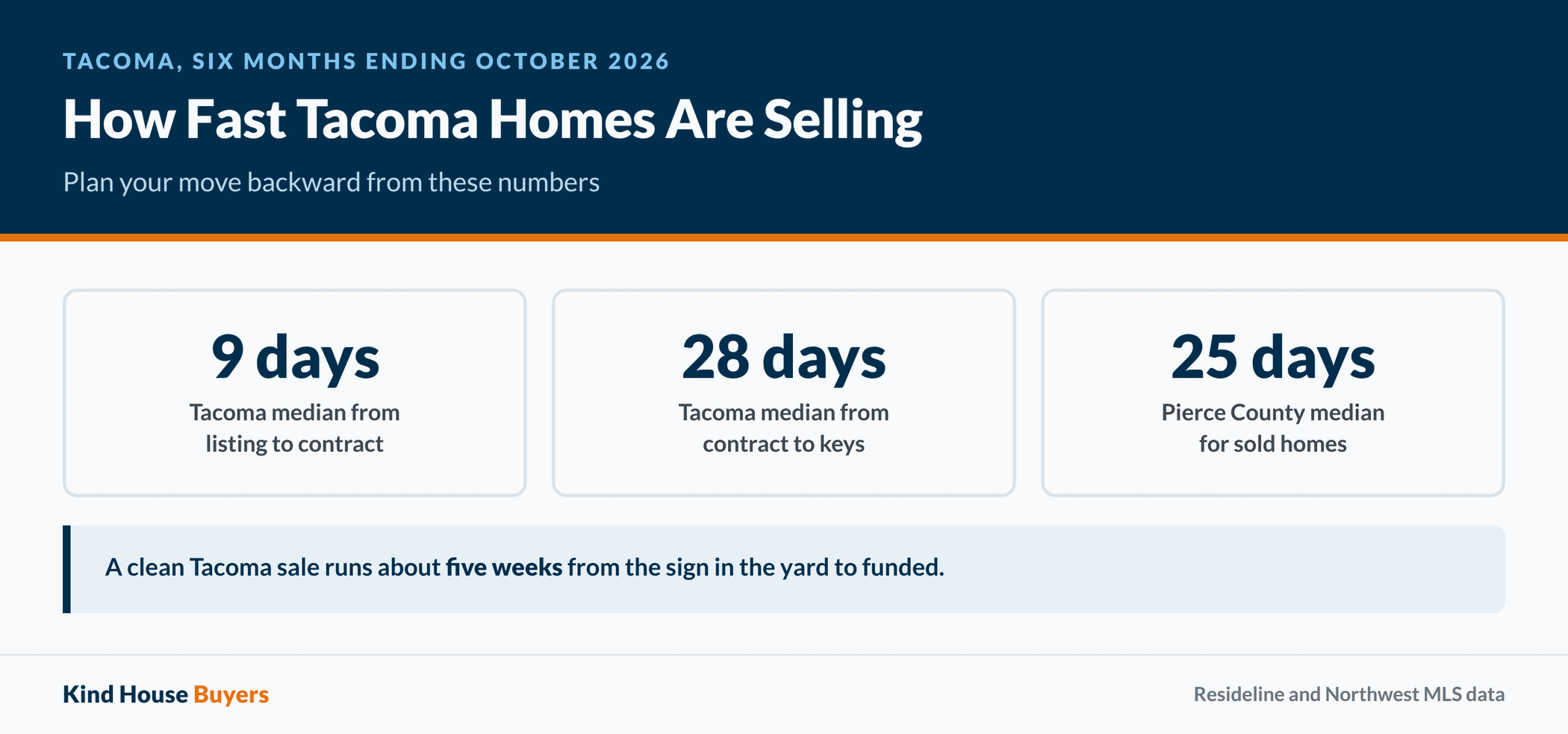
Plan backward, not forward. Start with your first day at the new job, subtract the closing window, then subtract two weeks for photos and prep. That’s the date you should be talking to someone, and most people I meet start that conversation three weeks late.
Pierce County as a whole has been running a 25-day median for sold homes, a bit quicker than the statewide figure in the October 2026 Northwest MLS extract. A North End craftsman near Proctor moves differently than a split-level off Pacific Avenue. Owners often assume citywide numbers apply to their street, and when you’re moving out of state that assumption rarely holds.
Should you list before you go, or after? My view after a lot of these: list before, close after. An occupied house with the lights on photographs warmer and shows better than an echoing one, and you’re still around to let the inspector into the garage.
Selling out of state after you’ve already moved is absolutely doable. It just piles on coordination costs that nobody puts in a spreadsheet.
Should You Sell to a Cash Buyer, Ibuyer, or List with an Agent?
A couple of years ago, a widow in Spanaway called me about a rental she’d inherited from her husband’s side of the family. She’d never wanted to be a landlord. The tenant had stopped answering the phone, her daughter in Arizona had a bedroom waiting, and the garage still held his fishing gear and a half-finished boat trailer.
You’ve got three paths, and each one trades money for certainty in a different ratio. Listing with a real estate agent on the open market usually brings the highest gross price, especially when homes are selling at or a little above list. You pay for that in time, showings, repair negotiations, and commission.
Selling for cash flips the equation. You give up some price and get a closing date you control, with no appraisal contingency, no lender, and no repair list. That matters a lot when you’re lining up a sale with a move out of state and a start date at a new employer.
iBuyers can be an odd fit for Tacoma sellers. Their service fees often land close to what a listing costs, their valuation models struggle with older Tacoma housing stock, and their repair deductions show up after inspection instead of up front.
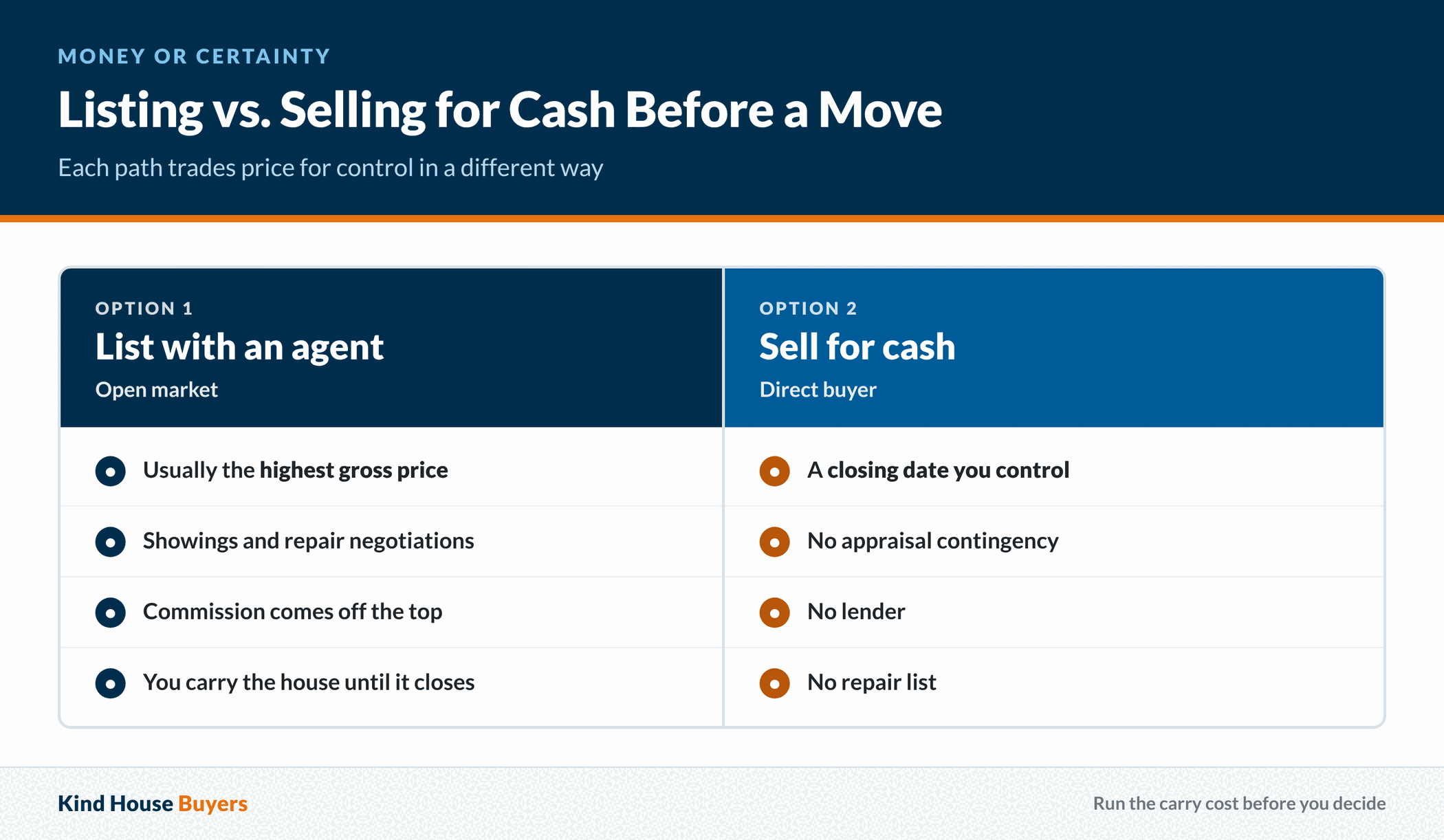
I’d push back on one piece of common advice. People say you should always list because you’ll net more. Netting more on paper while you carry a mortgage, utilities, insurance, and lawn care for four extra months from another time zone isn’t really netting more. Run the carry cost before you decide. Kind House Buyers will give you a cash number with no obligation, and comparing it to an agent’s estimate takes one afternoon.
Why You Need a Local Agent When Selling From Out of State
Picture a seller in Boise who picks a listing agent off a national referral site, prices the house from Zillow, and sits for seven weeks. Then a Tacoma agent who actually walks Hilltop and Fircrest reprices it, and it’s pending in under two weeks.
You can’t run a comparative market analysis like a formula from a thousand miles away. Pricing in this region swings with school boundaries, view corridors, and whether a street catches noise from I-5. An agent who knows a Stadium District view from a glimpse of Commencement Bay through a neighbor’s maple will price it right the first time.
Your agent also handles the physical work you can’t: letting in inspectors, meeting the appraiser, checking that a storm didn’t take shingles off, setting up a lockbox, and putting out the sign. Managing a sale out of state without boots on the ground is how small issues turn into price cuts.
Ask candidates two things. How many listings have you closed for sellers who’d already left, and how will you keep me updated? If the second answer is vague, keep looking.
Washington licenses its own agents, so a Realtor in another state can’t list your Tacoma house. They can refer you to someone here and collect a referral fee, which is a perfectly normal arrangement that costs you nothing extra.
Who Else Should Be on Your Remote Home-selling Team?
“Do I need an attorney for this?”
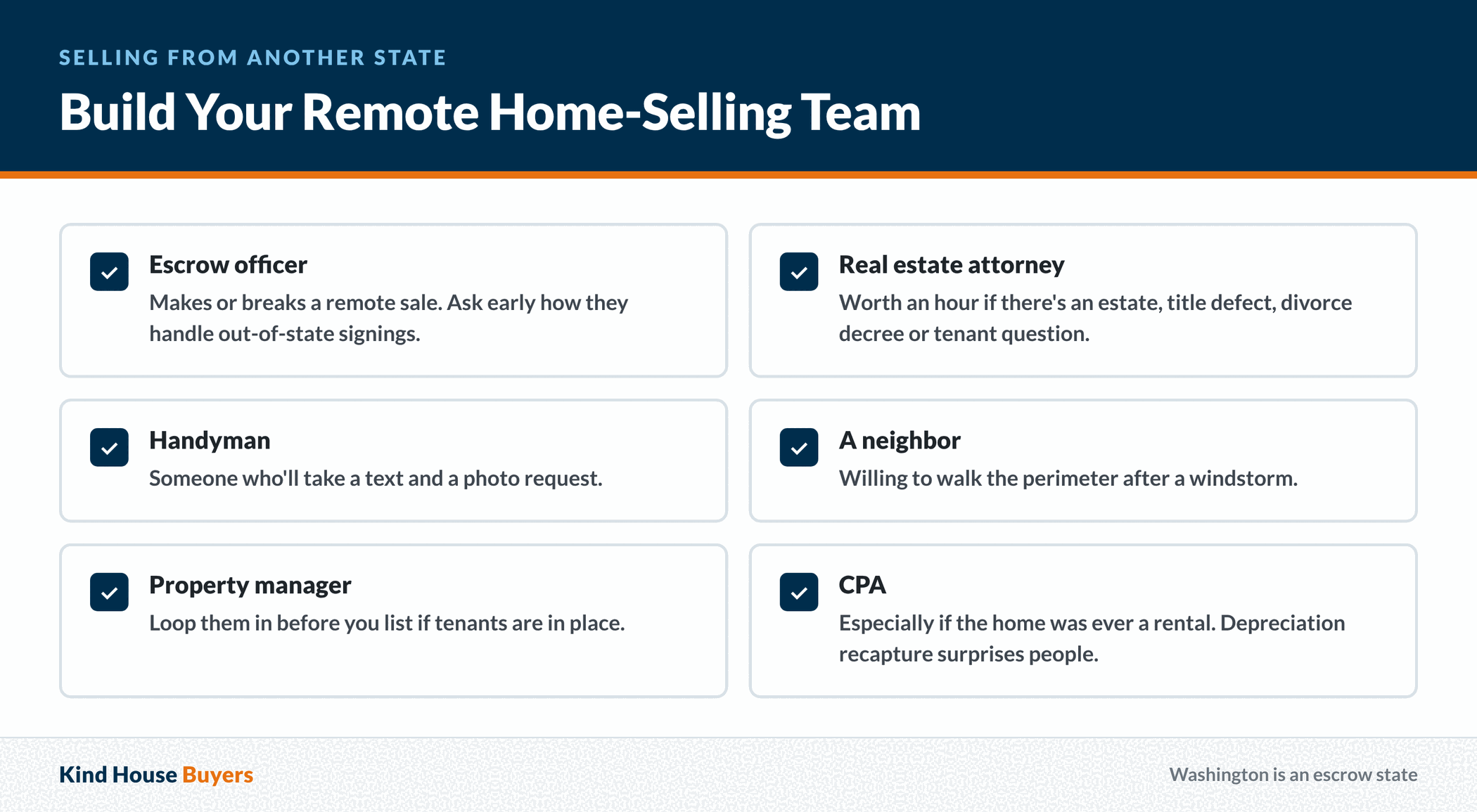
Washington is an escrow state, so most home sales here close through an escrow company rather than a closing attorney. You might still want a real estate attorney if there’s an estate, a title defect, a divorce decree, or a tenant whose rights you’re unsure about. An hour of legal review is cheaper than a delayed closing.
Your escrow officer is the person who quietly makes or breaks a remote transaction. Call early and ask how they handle signings for owners who live out of state.
Beyond escrow and your agent, put together a short bench. You want a handyman who’ll answer a text and a photo request, a landscaper on a biweekly schedule, and a neighbor willing to walk the perimeter after a windstorm. I’ve seen a frozen pipe cost a seller more than every repair they’d turned down during inspection.
If you’re selling investment properties with tenants in place, bring in a property manager before you list. Tenants have notice rights for showings, and a rental marketed to investors instead of owner-occupants often sells faster with the lease intact.
Line up a CPA as well, especially if the home was ever a rental. Depreciation recapture catches people off guard, and it’s easier to sort out before closing than during tax season.
How Do You Prep a Home for Sale When You’re Already Gone?
I used to tell sellers to paint everything before leaving town. I was wrong about that more often than I was right.
Fresh paint in a vacant house with cheap fixtures and a tired kitchen won’t change the buyer pool. Deep cleaning, a dialed-in yard, and professional photography do. Spend there first.
Virtual staging is good enough now that it’s worth the modest cost on a house you’re selling from out of state. A virtual tour and a floor plan also pull in relocating buyers who shop your market the same way you’re shopping your new one. The tech helps, but only on top of a clean, decluttered, well-lit property.
What about everything you can’t take? Estate liquidators, donation pickups, and junk haulers all book up in summer, so reserve early. A cleanout crew can empty a three-bedroom in a day, and deciding what to keep is what eats the week.
Selling as-is is not a failure. When the repair list exceeds what the price bump would cover, as-is is just arithmetic, and a direct buyer absorbs the condition instead of discounting it twice.
Washington’s seller disclosure statement still has to be filled out accurately after you’ve moved out of state. Answer honestly from memory, mark “don’t know” where you truly don’t, and let the buyer’s inspection handle the rest.
How Do Showings and Offers Work When You Can’t Be There?
That brings up the part that makes people nervous: strangers walking through your house while you’re unpacking in Phoenix.
Lockboxes and showing software handle access while you’re out of state. You’ll get a notification for every entry, and your agent sets the rules. Vacant homes can show to buyers on shorter notice, which usually means more foot traffic.
Offers come in by email, you review them on a video call, and you sign electronically, so you never have to be in the same room as anyone involved. Washington closings run on e-signature platforms, and your agent can walk you through a multiple-offer situation in real time from anywhere.
Competitive bidding changes the math. Tacoma homes have been selling at roughly one percent over list, with some drawing multiple offers and waived contingencies, according to Redfin’s Tacoma market data. A strong offer on a shaky loan is worth less than a slightly lower one backed by verified cash, and financing strength matters more when you can’t be nearby to rescue a fall-through.
Ask your agent to sum up each offer in plain terms: your net, the closing date, the contingencies, and how risky the buyer looks. The numbers alone won’t tell you which one closes.
Set a response window and stick to it. Sellers who take three days to answer from out of state lose good buyers to the next listing.
What Happens at Closing If You’ve Already Left the State?
Miss one notarization and your closing slides a week, your buyer’s rate lock expires, and everything starts to wobble.
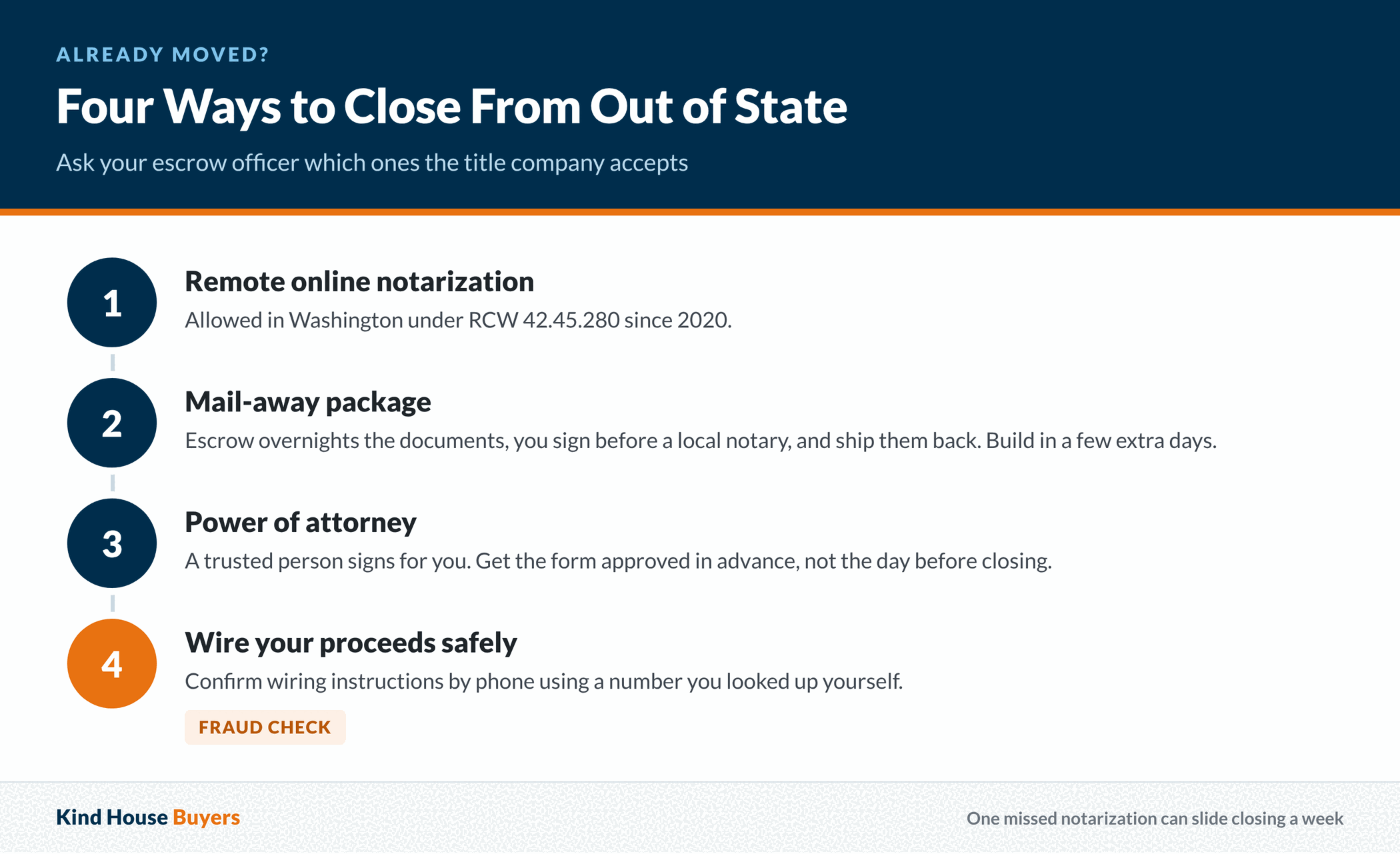
Washington allows remote online notarization under RCW 42.45.280, which took effect in 2020 and falls under the Department of Licensing, per the state’s notary framework. Washington also honors notarial acts properly performed by notaries in other states, so your escrow officer decides what the title company will accept. Ask them, not me, and ask early.
Mail-away packages are still common. Escrow overnights the documents to your new address, you sign in front of a local notary, and you ship them back. Build in a few extra days.
A power of attorney is the other route from out of state, letting someone you trust sign for you. Lenders and title companies have specific requirements for these, so get the form approved ahead of time rather than the day before closing.
Your proceeds arrive by wire. Confirm the wiring instructions by phone using a number you looked up yourself, never one emailed to you.
A woman in Puyallup reached out last year while settling her father’s estate. She’d been covering his mortgage alongside her own for close to eleven months, flying up every other weekend to mow and check the mail. His woodworking tools still filled the dining room. We closed on her schedule so she could stop writing two payments.
Do You Still Owe State Taxes After Selling and Moving Away?
Moving out of state doesn’t erase what’s owed on a sale that happened here. The tax that catches Washington sellers is the real estate excise tax, and it’s charged on the full sale price rather than your profit.
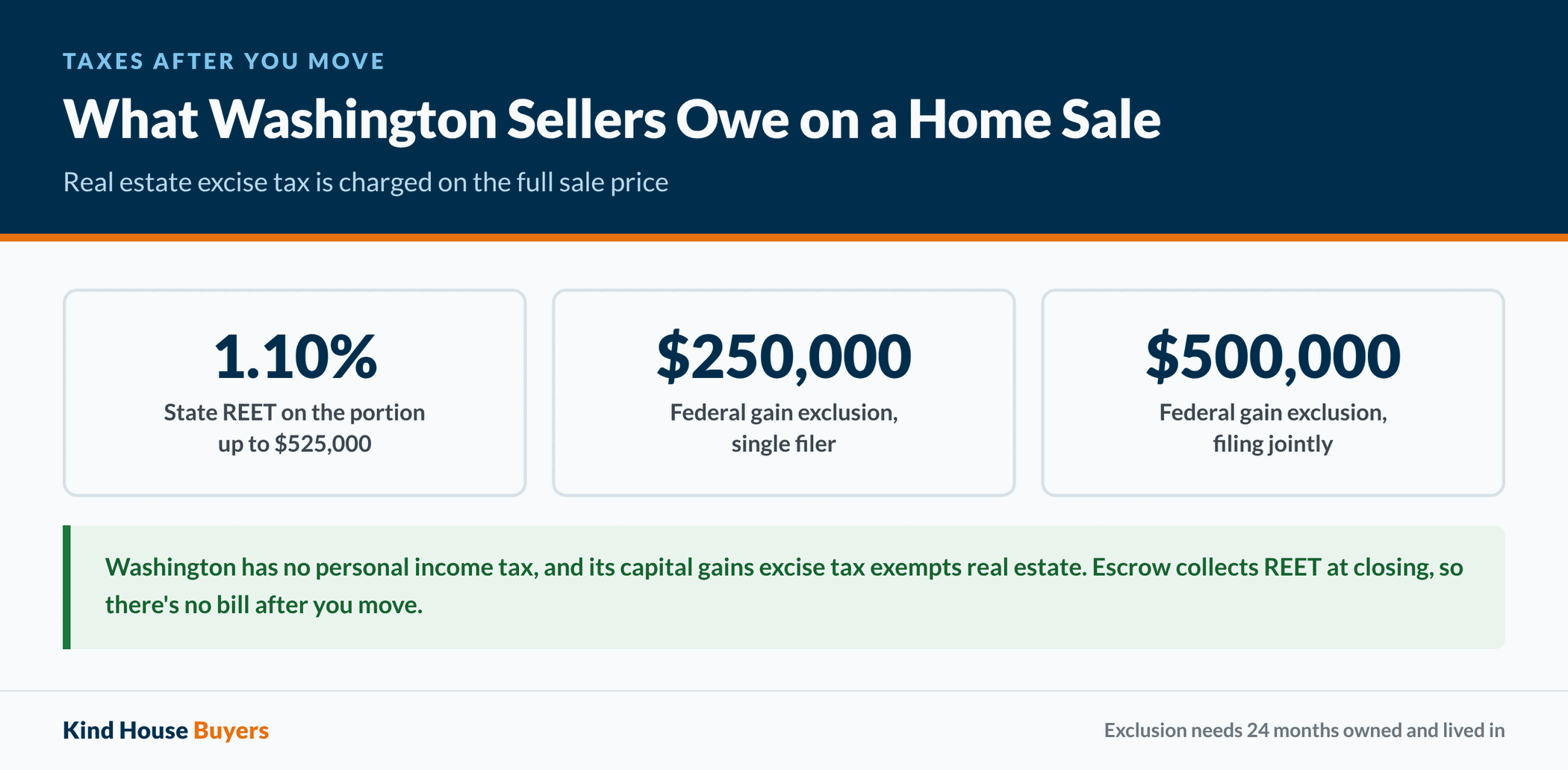
REET is graduated. The state portion starts at 1.10 percent on the part of the price up to $525,000 and climbs through higher brackets above that, as laid out in the Department of Revenue’s rate structure. Cities and counties add a local piece on top, often a quarter point to a half point. Escrow takes it out of your proceeds at closing, so no bill follows you after you’ve moved out of state.
Washington has no personal income tax, and the state’s capital gains excise tax specifically exempts real estate. Federally, you may exclude up to $250,000 of gain as a single filer or $500,000 filing jointly, per IRS Topic 701. To qualify, you need to have owned and lived in the home for at least 24 months of the five years before the sale. Your new state may tax things differently, so ask a CPA licensed where you’re landing.
Frequently Asked Questions
After the Sale Closes, How Long Do You Have to Move Out?
Possession is set in the purchase agreement, not by law. Most Washington contracts hand over possession at closing or shortly after, though a rent-back of a few days to a few weeks is common when a seller needs more runway. Ask for the possession terms you need up front, since buyers are often flexible when you tell them early.
What Would the Commission Be on a $300,000 Sale?
Commission rates are negotiable and always have been. In this market, the listing side and the buyer’s side each commonly run in the low-to-mid two percent range. A sale at that price could cost somewhere in the mid-teens of thousands of dollars combined. Since the 2024 industry settlement, buyer-side pay is negotiated separately instead of assumed. Get the number in writing before you sign a listing agreement.
Do You Need 20 Percent Down to Buy a Home in Your New State?
No. Conventional loans go well below that with mortgage insurance, and second-home financing usually asks for more down than a primary residence, though not necessarily a fifth of the price. If you’re buying before your current house sells, ask a lender about bridge financing, which lets the equity in your old home act as your down payment.
Can a Real Estate Agent From Another State Sell Your Washington House?
Not directly. Licensing is state by state, so an agent elsewhere can’t list or represent you on a Washington property. They can refer you to a licensed local agent, which happens all the time and adds no cost to your side.
Does Selling From Another State Change How Much You Net?
On its own it doesn’t, though the carrying costs usually do. Each month you hold a house you’re not living in adds mortgage, insurance, utilities, and upkeep to the ledger. That’s why people selling from out of state often net less than their listing estimate predicted. Price it realistically and most of that gap goes away.
If you’re weighing a listing against a cash offer and just want someone to talk through the real numbers with you, we’re glad to help. No pressure, no obligation, and no hard feelings if listing turns out to be the better move. You can reach us anytime at Kind House Buyers, and if all you need is a straight answer to one question, ask us that question.
Your Tacoma House and Your Moving Date
Tacoma is where Kind House Buyers is based, and plenty of the sellers we meet here are already halfway packed. Statewide, homes that sold in the October 2026 Northwest MLS data spent a median of 28 days on the market. We buy houses across Pierce County and throughout Washington, and we can set the closing date around your moving truck.
Moving Out of State Soon? Let’s Talk
If your start date is set and the house isn’t sold yet, we can close on your schedule, even after you’ve left. Tell us about the property, and we’ll give you a cash offer you can review and sign remotely. Reach out to Kind House Buyers or use the form below.