
Nobody opens their Pierce County tax statement expecting good news. The number on that paper can stop a homebuyer’s budget math cold. It can also eat into a landlord’s cash flow for years before anyone notices. Owning property in Tacoma, WA, or thinking about buying here, means understanding how property taxation works in this city is worth your time.
How Property Tax Works in Washington State
A lot of people picture property tax as a simple percentage slapped onto their home’s value every year, like sales tax at checkout. Longtime homeowners are often surprised by how layered it gets.
Your property tax bill is composed of taxes levied by the state, counties, cities, and schools. Several “junior” taxing districts pile on too, such as fire districts and hospitals. So your annual statement is not showing you one tax. You’re seeing a stack of levies from overlapping government bodies. Each one has its own rate and its own statutory cap.
There are 121 taxing districts in Pierce County alone. Because the boundaries are irregular and overlap each other, those districts produce 241 distinct tax code areas. This is why a homeowner in the North End of Tacoma can have a meaningfully different bill than someone four miles away in Fircrest or University Place. Their homes can be worth roughly the same amount. I’ve watched that gap surprise buyers more than once.
Article VII, Section 2 of the Washington State Constitution caps the aggregate of all regular tax levies on real and personal property at 1%. That works out to $10 per $1,000 of true and fair value. Voter-approved excess levies sit outside that cap. That’s why school bond measures passed by Tacoma voters show up as a separate line item, and why they can push the total well above the base rate in high-levy districts.
How Washington State Calculates and Collects Property Tax

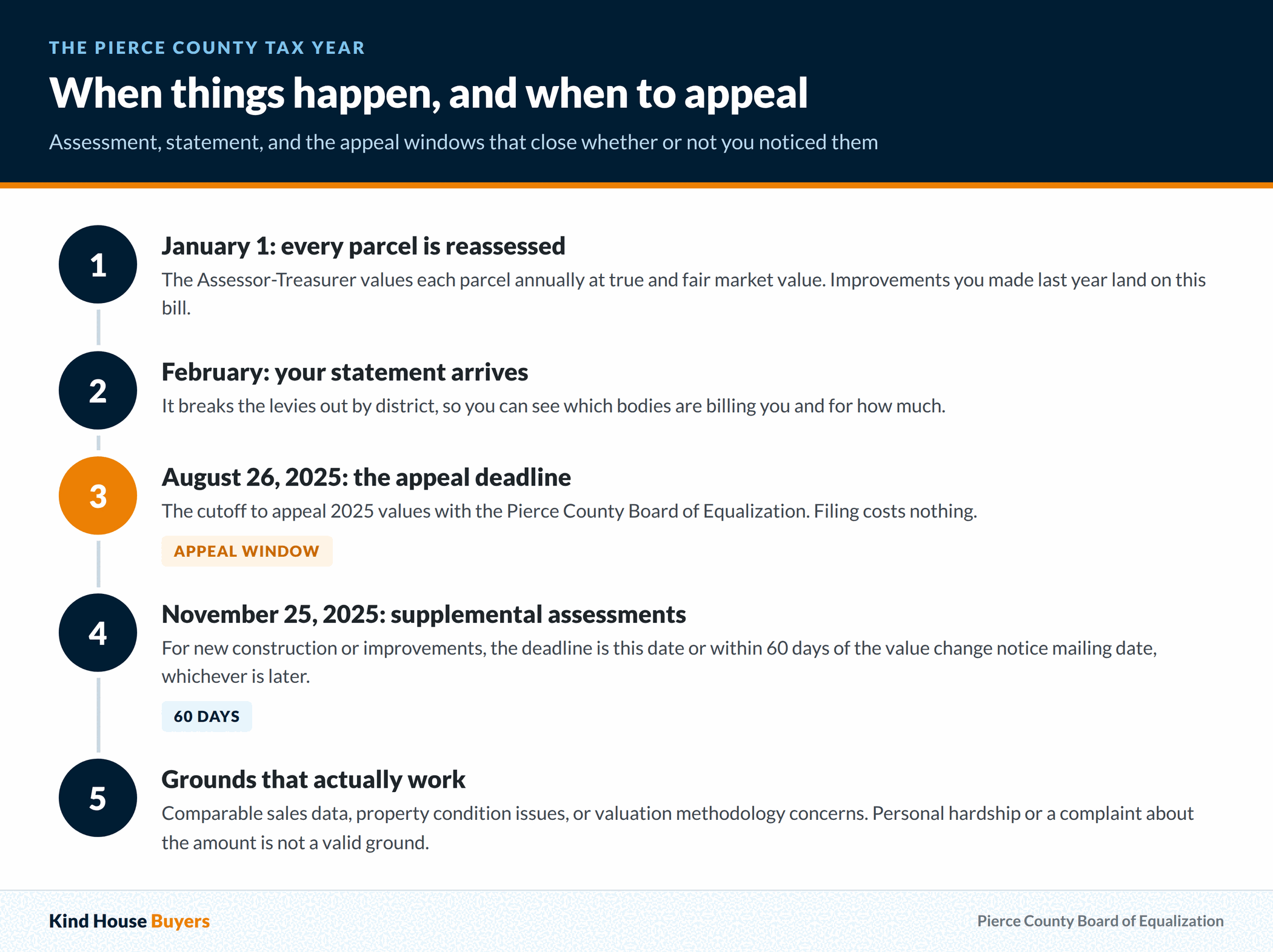
Washington uses a 100% assessment ratio. Properties get assessed at true and fair market value. The total tax combines the state school levy, local school levy, county, city, and special district rates, typically expressed as dollars per unit of assessed value. The Pierce County Assessor-Treasurer reassesses every parcel annually as of January 1st. Any improvements you made the previous year can affect your next bill.
State law caps how fast a taxing district can grow its tax take. The limit resets annually. A city that levies $1 million in property taxes can only levy $1.01 million the next year, plus revenues from new construction, improvements, and newly added utility values. What pushes your individual bill up faster is your home’s assessed value rising faster than the county average. Your share of the total levy pool grows even when the pool itself barely moves. A reno permit can trigger exactly that.
Your annual property tax statement, received every February, provides a breakdown of these levies by district. You can see which bodies are billing you and for how much.
What Factors Determine Your Property Tax Bill in Tacoma?
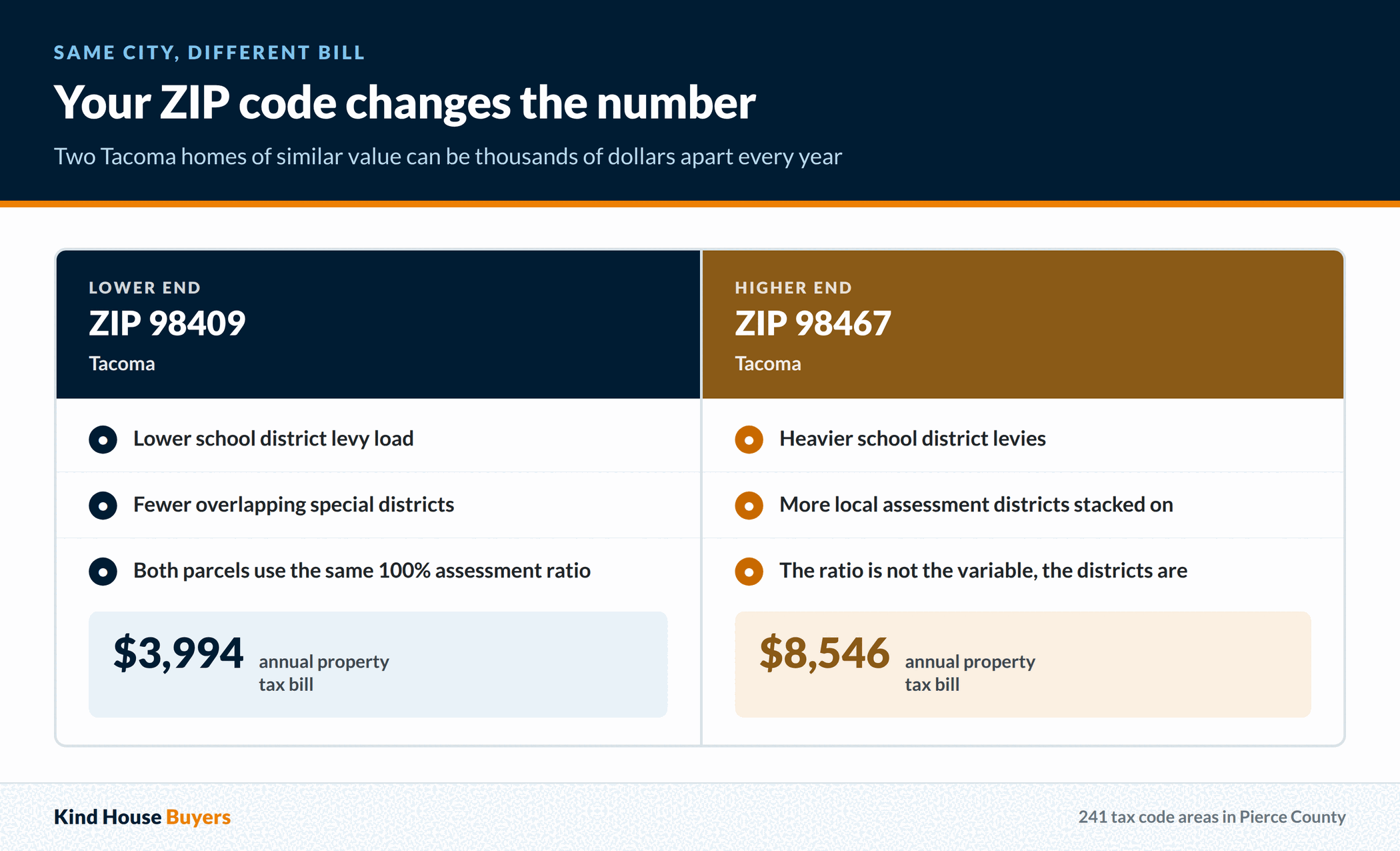
Why does your neighbor pay a different rate than you do? Your ZIP code shapes your Tacoma property taxes more than most people realize.
Bills vary by ZIP code within Tacoma. Rates range from $3,994 in 98409 to $8,546 in 98467, primarily due to differences in school district levies and local assessment districts. A buyer comparing two similar homes on opposite sides of the city might be looking at thousands of dollars in annual tax difference. That gap adds up over a 30-year hold. Many real estate conversations skip right past that.
Three factors drive your specific bill. Your home’s assessed value is the first. The combined levy rates of every taxing district covering your parcel is the second. Third is any voter-approved excess levies your neighbors have supported at the ballot box. The total rate combines all overlapping districts: state school, local schools, county, city, EMS, library, fire, park, flood control, and cemetery, depending on location. And yes, cemetery districts are real.
Not long ago I worked with a landlord in the Hilltop neighborhood who had been quietly covering two mortgages for almost a year while a rental sat empty. When we pulled the actual tax assessment alongside the rehab quotes, his annual tax burden was a bigger drag on his numbers than he had factored in. The taxes hadn’t changed. They looked very different once we laid everything out on paper together. This kind of oversight is more common than you’d think.
What Are the Property Tax Rates in Tacoma, Wa?
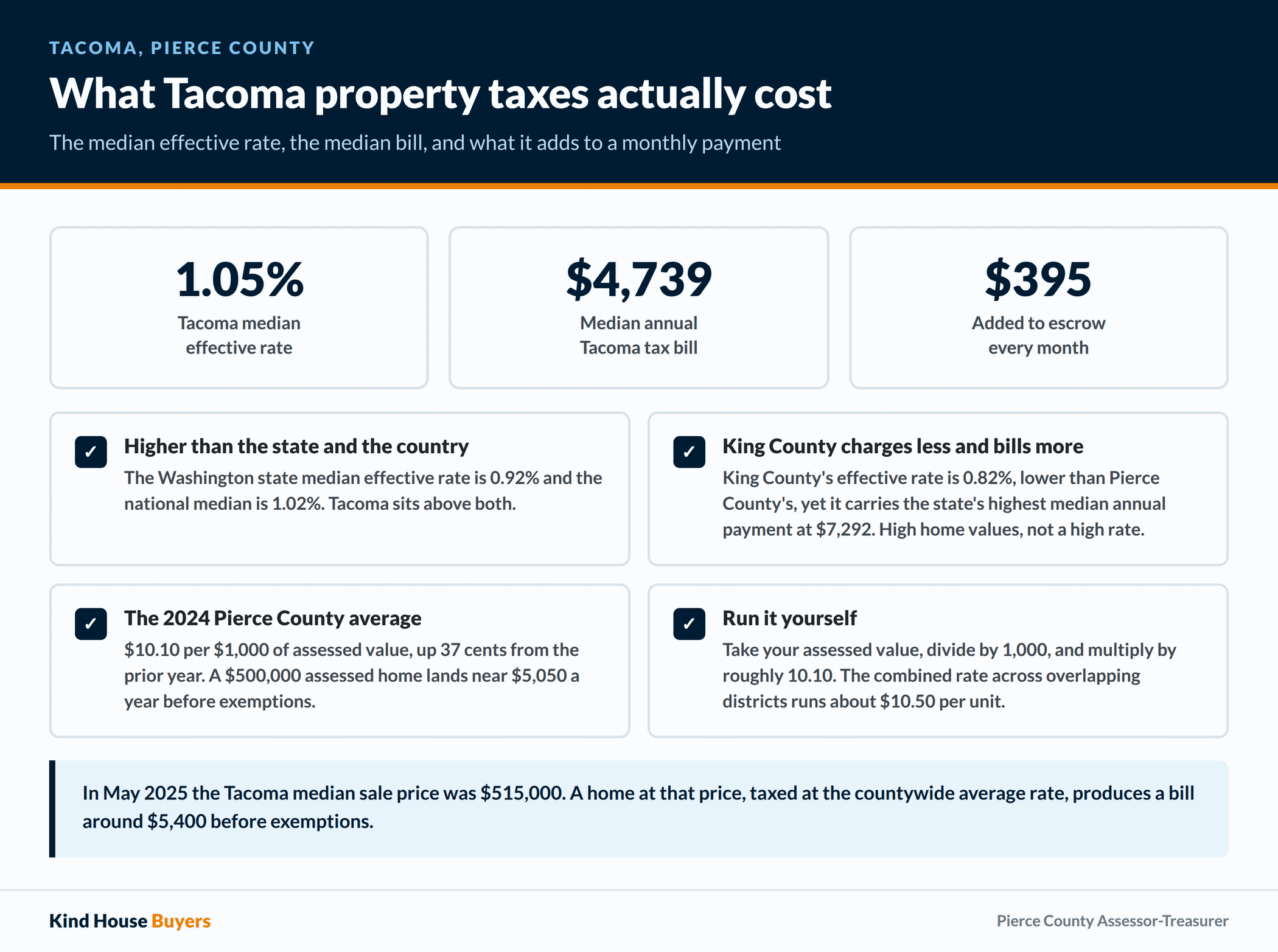
Tacoma’s median effective property tax rate sits at 1.05%. That is higher than both the Washington state median of 0.92% and the national median of 1.02%. The median annual Tacoma property tax bill comes out to $4,739, adding roughly $395 to your escrow payment every month. For buyers taking out a loan, that figure gets rolled into escrow and affects monthly payment calculations from day one.
In 2024, Pierce County’s average property tax rate increased to $10.10 per thousand dollars of assessed value, up 37 cents from the prior year. That per-thousand figure is the clearest way to translate your home’s assessed value into a rough annual tax estimate. Take your assessed value, divide by 1,000, and multiply by roughly 10.10. A $500,000 assessed home comes out near $5,050 a year before any applicable exemptions.
Pierce County’s combined rate across all overlapping districts runs approximately $10.50 per unit of assessed value, consistent with the effective rate noted above. Keep these figures in mind as you evaluate any property in Tacoma. Write them down before you tour, so you can run quick mental math on the spot.
How Tacoma Property Tax Rates Have Changed Over Time
Tacoma’s rates have held steady by design. The total dollars homeowners pay have climbed anyway, alongside rising assessed values. When property values rise, the levy rate decreases automatically, so total revenue grows only marginally per year per district. That cap catches a lot of buyers off guard. New construction and voter-approved excess levies sit outside it.
Countywide, the average residential property value increased 6.2% from $521,300 to $553,000 in 2024. The largest increases, around 7%, showed up in Tacoma, Lakewood, Orting, Puyallup, Sumner, and Eatonville. A 7% jump in assessed value means a larger slice of the levy burden lands on those homeowners, even if the levy rate ticks slightly down.
Property taxes have increased in recent years primarily because of new voter-approved levies supporting things like school construction. That’s the political lever no statutory cap controls. When Tacoma voters approve a school bond or a park levy, those excess levies add directly to bills above the constitutional ceiling on regular levies.
How Tacoma Property Taxes Compare to Other Washington Counties

King County’s effective property tax rate is 0.82%, and it carries the state’s highest median annual property tax payment at $7,292. That number is driven by sky-high home values rather than a punishing rate. The rate itself is actually lower than Pierce County’s. Buyers who move from Seattle to Tacoma often find their effective rate is higher here. Their actual dollar bill may still be smaller, because Tacoma home prices are lower.
In May 2025, the Tacoma median sale price was $515,000, up 7.3% compared to the prior year. A home at that price, taxed at the countywide average rate, produces an annual bill around $5,400 before exemptions.
County taxable real property value increased from $197.5 billion to $203.7 billion in the most recent assessment cycle. More taxable value in the pool generally helps hold individual rates down. It doesn’t erase the impact on households whose own values rose faster than the countywide average. If you’re comparing properties across Pierce, King, or Thurston counties, run the tax math separately for each one rather than assuming the rate is similar. I’ve bought in neighboring counties, and the difference can be surprisingly significant.
What Exemptions and Relief Programs Are Available to Tacoma Homeowners?
A retired schoolteacher in the Proctor District hadn’t touched her assessed value in a decade. When she finally sat down with the Assessor-Treasurer’s office, she discovered she’d been eligible for a senior exemption for years and had never applied.
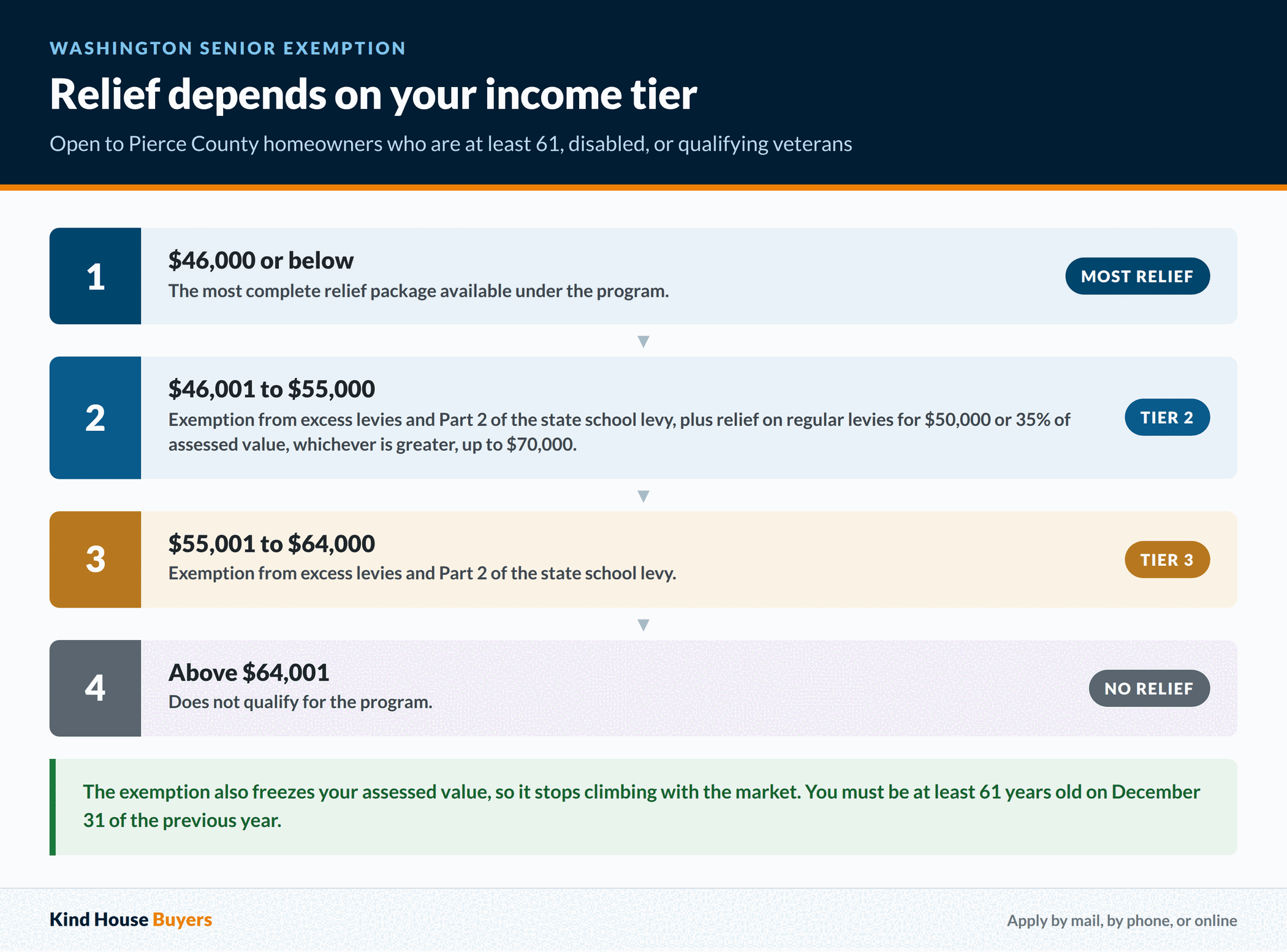
Pierce County homeowners who are at least 61, disabled, or qualifying veterans can reduce their annual property tax bill through Washington’s senior exemption program. The benefit scales with household income. At one end it eliminates certain voter-approved levies. At the other it exempts a portion of the home’s assessed value from regular taxes. It also freezes that assessed value, so it stops climbing with the market.
Households with income above $64,001 do not qualify. Filers in the $55,001 to $64,000 tier earn an exemption from excess levies and Part 2 of the state school levy. Earners in the $46,001 to $55,000 tier get those same exemptions plus relief on regular levies for $50,000 or 35% of assessed value, whichever is greater, up to $70,000. Households earning $46,000 or below receive the most complete relief package available. Worth understanding before you assume the program won’t help you.
To qualify, you must be at least 61 years old on December 31 of the previous year. Applications can be submitted by mail, by phone, or online, so you don’t need to show up in person to get the process started. The Pierce County Assessor-Treasurer’s office at piercecountywa.gov/702 is the right starting point.
If you’re weighing a sale partly because the tax burden has become unmanageable, talking to Kind House Buyers before you decide is worth a call. They work with homeowners in exactly this situation and can help you figure out whether selling, applying for relief, or another path makes more sense for your specific numbers.
Where to Pay and How to Appeal Your Tacoma Property Tax Assessment
The system is not impossible to beat. Most people who overpay on property taxes do it because they never challenged the assessment.
If you believe your assessed value doesn’t reflect fair market value, you can file an appeal with the Pierce County Board of Equalization at no cost. August 26, 2025 was the appeal deadline for 2025 values. For supplemental assessments from new construction or improvements, the deadline is November 25, 2025, or within 60 days of the value change notice mailing date, whichever is later. Check directly with the Pierce County Assessor-Treasurer for current deadlines, since windows can shift year to year.
Appeals must include specific reasons why the assessor’s value doesn’t reflect true and fair market value. Acceptable grounds include comparable sales data, property condition issues, or valuation methodology concerns. Personal hardship, tax amount complaints, or assessment percentage increases alone are not valid grounds.
A woman settling her father’s estate in South Tacoma came to us three months behind on the mortgage with an auction date already set. The assessed value hadn’t been challenged in years, and the county’s number was running higher than comparable sales supported. She hadn’t known she could appeal. We closed fast enough to stop the auction, and she walked away with money in hand. If the appeal window is still open for your property, it costs nothing to try.
Kind House Buyers has helped homeowners across Tacoma sort through exactly these situations. Overvalued assessments, properties buried in back taxes, all of it.
The Washington Department of Revenue’s property tax page and the Pierce County levy reports are the two authoritative sources to bookmark if you want to track rate changes year to year.
Frequently Asked Questions
Which City in Washington State Has the Highest Property Taxes?
King County cities like Seattle carry the highest median annual property tax payments in Washington, with the county median coming in around $7,292 per year. That’s driven by very high home values more than by high rates. King County’s effective rate is actually lower than Pierce County’s. Total dollar outlay and effective rate tell two different stories, so check both before drawing conclusions.
Do Senior Citizens Have to Pay Property Tax in Washington State?
Senior citizens in Washington are not fully exempt from property taxes, but the state offers a meaningful reduction program for those who qualify. In Pierce County, homeowners qualify on three tests. You have to be 61 or older by December 31 of the prior year. You have to own and occupy the home as a primary residence. Combined household income has to land under $64,000. Meet all three and you may qualify for exemptions from certain levies and a freeze on your assessed value. The relief amount depends on which income tier you fall into, so contacting the Pierce County Assessor-Treasurer’s office is the clearest path to finding your specific benefit.
What Is the Tax Rate in Tacoma, Wa?
Tacoma’s median effective property tax rate is 1.05% of assessed value, which translates to a combined levy rate of roughly $10.50 per $1,000 of assessed value across all overlapping taxing districts. Your individual rate will vary depending on your specific ZIP code and which school district, fire district, and other local taxing bodies cover your parcel. The median annual tax bill in Tacoma runs around $4,739.
What Is the Pierce County Property Tax Rate?
Pierce County’s effective property tax rate sits at approximately 1.05%, and the average rate came in at $10.10 per $1,000 of assessed value for 2024. That figure covers the combined regular levies from the state, county, city, and local districts. Voter-approved excess levies can push individual bills higher, depending on where your property sits within the county’s 241 tax code areas. The Pierce County Assessor-Treasurer’s office at piercecountywa.gov/atr can give you the exact combined rate for any specific parcel.
Maybe you want to talk through how your property taxes affect your options as a seller. Maybe carrying costs have made holding onto a Tacoma home harder than it used to be. Either way, reach out to Kind House Buyers. No pressure, no obligation. Just a real conversation with people who know this market and want to help you find the right path forward.
Selling a Tacoma Home When the Tax Bill Stops Making Sense
Tacoma is our home market, and the tax math is a big part of why people call us. The typical Tacoma home value sat at $496,203 as of July 31, 2026, down a tenth of a percent over the year. When values flatten but levies keep stacking, the carrying cost stops feeling temporary. That is usually the point where a landlord with a vacant unit, or an heir holding a house nobody lives in, starts running the numbers seriously.
We buy throughout Pierce County and the surrounding metros, including Federal Way, Auburn, Kent, Olympia, and Port Orchard. Our how it works page lays out what the process looks like from first call to closing.
Run Your Numbers Before You Decide Anything
Sometimes the answer is an exemption application or an appeal, and it costs you nothing to find out. Sometimes the house has simply outgrown what it earns. We are not going to tell you to sell a home that still works for you. We will tell you what we would pay and what your other options look like, and you can take it from there.
You can browse common questions for Kind House Buyers if you want to read first. When it makes sense to talk, contact us and we will walk through your numbers with you. There is no cost and no obligation. The short form below is the quickest way to start.