
A letter shows up on a Tuesday. Your carrier isn’t renewing. You’ve never filed a claim, the roof is fine, and suddenly you’re calling agents who won’t call back. I’ve seen this happen to sellers in the middle of a sale, and that scramble has become ordinary. Numbers back it up: an Insurify analysis found roughly 14% of American homes carry no coverage at all. Losing homeowners insurance doesn’t just cost you a policy. It touches your loan, your escrow, your ability to sell, and sometimes your whole plan for the house.
I buy houses for a living, and homeowners insurance problems now come up in conversations where they never used to. Sellers bring it up now before they mention the roof or the kitchen.
Is Homeowners Insurance Legally Required in Your State?
Zero. That’s how many states have a law on the books forcing a homeowner to buy homeowners insurance on a house they own free and clear. No legislature in the country treats it like auto liability coverage.
The requirement almost always comes from a contract, not a statute. A mortgage is the thing that demands coverage, and your lender enforces it.
Still, a missing state law doesn’t mean the state is silent. Insurance departments regulate carriers heavily: what they can charge, how much notice they owe you before dropping you, how fast they have to pay. California, for instance, doesn’t require homeowners insurance by law, yet mortgage servicers do, and the market there has tilted hard toward the state’s insurer of last resort.
Condo and HOA owners live under a second layer. Your association’s bylaws are a binding agreement, so most of them require unit owners to carry a policy covering the interior and personal liability. Break that rule and the HOA can fine you or place a lien.
One owner I met had stopped opening the mail from his servicer. When we finally sat at his kitchen table on a Saturday, the escrow shortage had grown larger than the repair list he’d been avoiding.
Does your insurer have to notify you in writing before nonrenewal? Most do, and the required notice period differs from state to state. Your state’s department of insurance can tell you the exact window that applies to your policy. Call that office rather than your agent, who may be the one delivering the bad news.
Which Properties Don’t Need Homeowners Insurance?
Pay off the mortgage and the homeowners insurance obligation disappears with it, which sounds simple enough. The catch is that the contractual requirement vanishing doesn’t make the financial exposure vanish, and plenty of owners discover that distinction the hard way after a kitchen fire.
Free-and-clear homes are the biggest category of legitimately uninsured property in America. An earlier Insurify report found owners without a mortgage were seven times as likely to go uninsured. Alabama, where 18.9% of homes carry no coverage, shows how high that can run.
Inherited houses slip through too. An heir gets the keys, the deceased owner’s policy terminates, and nobody tells the estate. Vacant-home exclusions do the rest.
Land is different. Raw lots, unimproved acreage, and parcels with nothing but a well don’t carry dwelling coverage because there’s no dwelling to cover.
Mobile homes occupy a strange middle ground. Units titled as vehicles rather than real property fall outside standard homeowners insurance, and owners need specialty manufactured-home policies instead. Lenders financing those units set their own coverage terms.
A house doesn’t need homeowners insurance to be sold, transferred, or lived in. It needs coverage to be financed. If a buyer is bringing a loan, that buyer’s lender will demand a policy before funding, and a house no carrier will write becomes a house most retail buyers can’t finance. That’s the squeeze.
In those sales, financing is the problem, not price.
What Does Your Mortgage Lender Require for Homeowners Insurance?
A seller called me after her monthly payment jumped by several hundred dollars with no warning. Her carrier had dropped her in the spring, she’d meant to shop for a replacement, and her servicer bought one for her instead.
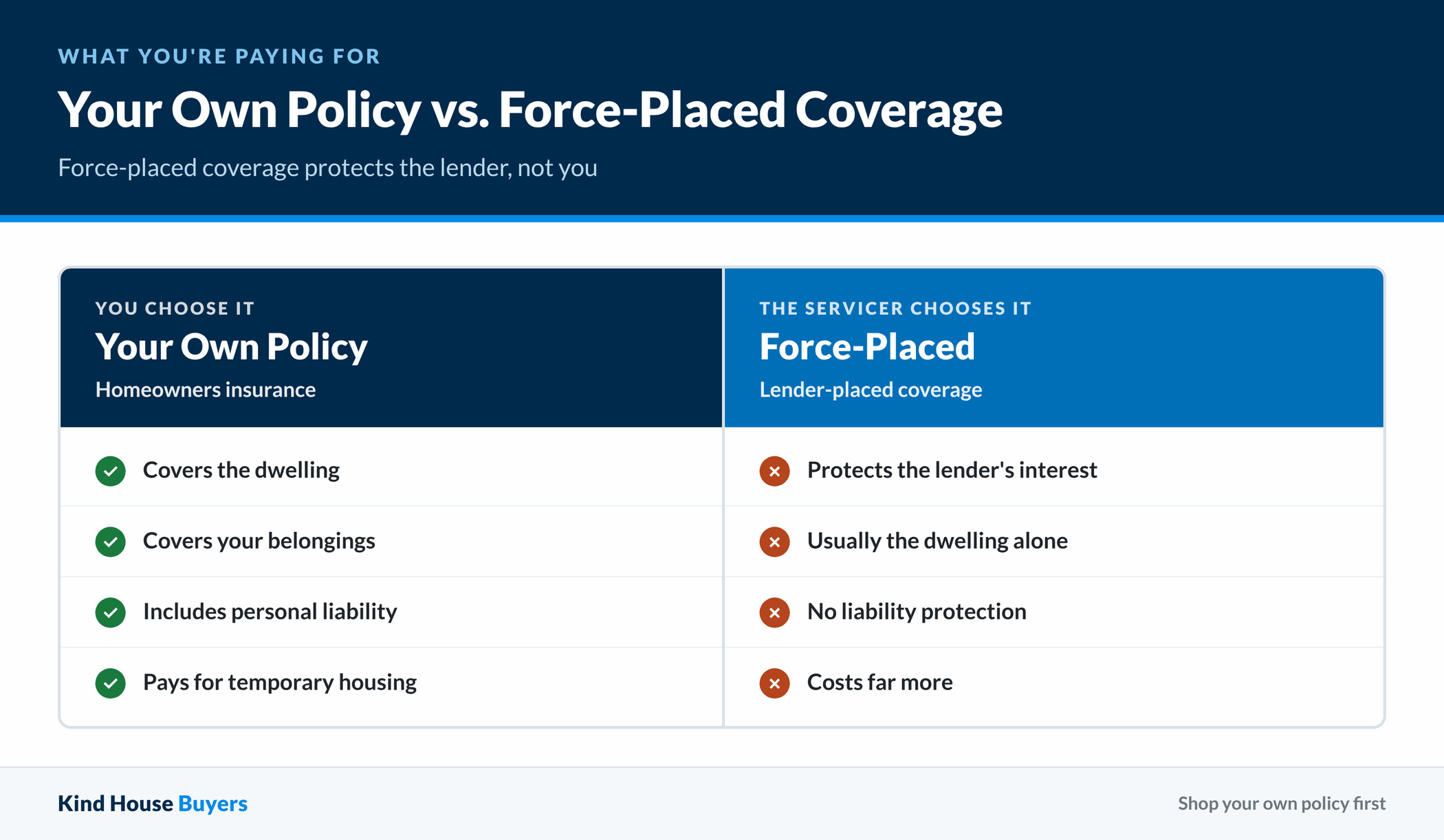
Force-placed coverage is the mechanism every borrower should understand. Federal rules define it as hazard insurance a servicer obtains on behalf of the loan’s owner to insure the property securing that loan. These policies usually cost far more than a standard policy, protect only the lender’s interest rather than your belongings, and land in your escrow account.
Before a lender can slap force-placed coverage on your mortgage, they have to tell you, giving at least 45 days notice. They can’t actually place the policy until 15 days after sending a second notice. Two letters, then the charge.
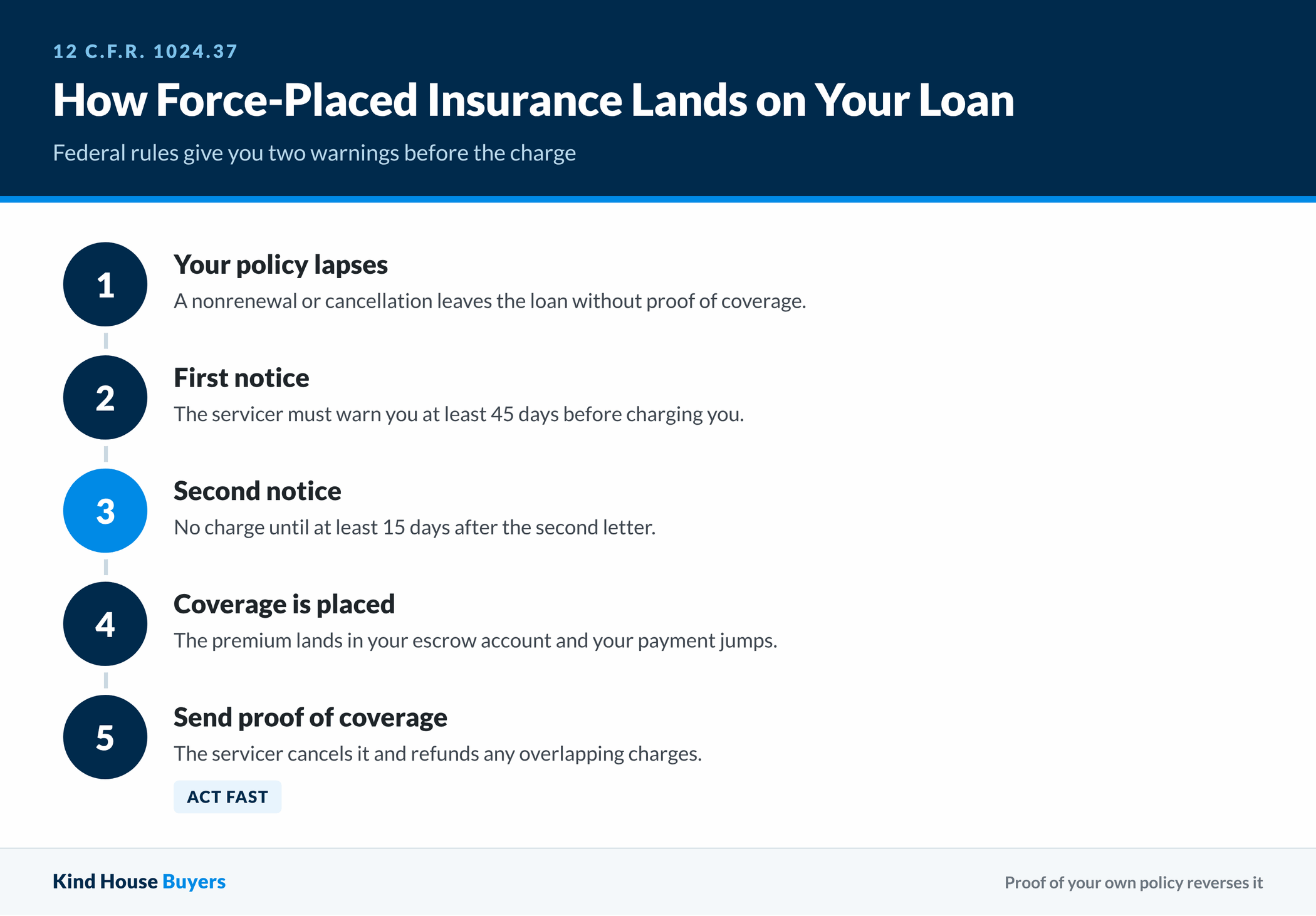
Move fast and you can fix this quickly. Under 12 C.F.R. §1024.37, once your servicer receives proof of your own coverage it has a short window to cancel the force-placed policy. It must refund premiums and fees you paid for any overlapping period, and strip those charges from your account. The Consumer Financial Protection Bureau publishes the full rule text, and it’s worth a read before you argue with a servicer.
What does your lender actually require? Usually homeowners insurance with dwelling coverage at replacement cost or the loan balance, the servicer named as mortgagee, and proof on file at every renewal. A policy that doesn’t list your lender as mortgagee can trigger force-placement even though you’re fully covered.
Why Would an Insurer Deny or Drop Your Homeowners Insurance?
Before: a 1970s ranch with a 22-year-old roof, insured by the same carrier since the owner bought it. After: a nonrenewal notice citing roof age, issued nine months after the carrier fully exited that county.
Nothing about the roof changed. The insurer’s appetite did, and that’s the single biggest driver of denials right now.
NAIC research found company-initiated nonrenewal rates rose between 96% and 216% across four U.S. regions from 2018 to 2024, with inflation-adjusted premiums up 18.3% to 43.3% over the same stretch. Individual states have gotten uglier still. Utah led the nation in 2025, with roughly 4.5% of homeowners policies not renewed, about 1.5 points above second-place California.
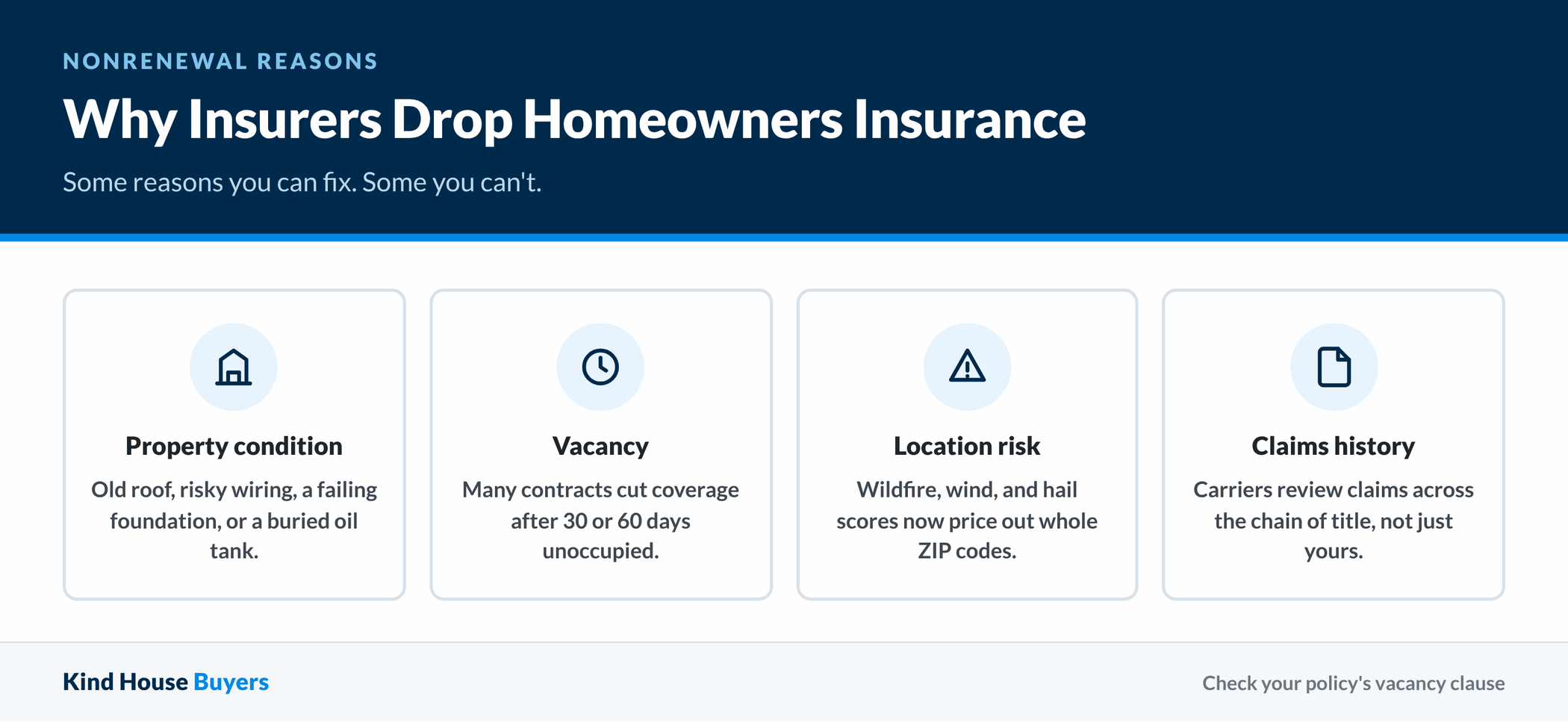
Carriers flag an old roof, knob-and-tube or aluminum wiring, and a failing foundation. An unfenced pool, an unpermitted wood stove, or a buried oil tank can sink a homeowners insurance application too. Carriers also look at claims history across the chain of title, not just yours.
Vacancy ends homeowners insurance policies quickly. Most standard contracts cut off coverage after 30 or 60 days of an unoccupied dwelling, and the exact number sits in your policy’s vacancy clause rather than in any statute.
Then there’s the reason nobody wants to hear: your ZIP code. Wildfire scores, coastal wind exposure, hail frequency, and reinsurance costs now price out neighborhoods that were routine ten years ago. A roof can be replaced. You can’t relocate a parcel.
What Happens If Your Home Has No Insurance Coverage?
“If nothing burns down, who gets hurt?”
Owning free and clear without homeowners insurance, you’re self-insuring. A total loss means you absorb the rebuild and any liability judgment yourself.
Carrying a mortgage without homeowners insurance puts you in default on a contract, not just at financial risk. Because a lapse violates your mortgage terms, the servicer can move to foreclose if you neither buy your own policy nor reimburse it for lender-placed coverage. Foreclosure over insurance alone is uncommon, but it’s legally available, and that’s a position worth avoiding.
Buyers using conventional, FHA, or VA financing all need a bound policy at closing. No policy, no loan, no closing.
Many owners in that spot end up selling to a cash buyer. It’s one of the better reasons homeowners reach out to a company like Kind House Buyers when a property has become uninsurable; a buyer paying cash isn’t blocked by an underwriter’s coverage requirement.
Repairs get harder too. Storm damage with no carrier behind it means out-of-pocket contractor bills, and deferred repairs compound into bigger underwriting problems later.
Liability is the exposure people forget. A delivery driver slips on your porch steps, and without personal liability coverage you’re defending that claim with your own money and your own attorney.
How Much Does It Cost to Go Without Homeowners Insurance?
“Premiums are robbery at this point, I’d rather bank the money.” I hear that, and for a paid-off house with real savings behind it, self-insuring isn’t crazy.
What does coverage run? Homeowners insurance averages about $2,490 a year nationally, roughly $208 a month, per NerdWallet’s 2026 analysis of $400,000 in dwelling coverage. The spread is enormous: Oklahoma tops the list, and Vermont sits at $1,170.
Now put that next to the replacement cost of your house.
Force-placed coverage is the expensive middle path, and it buys you less than your own policy would, since it’s only designed to protect the lender’s interest. Your furniture, your detached garage contents, your liability, your temporary housing after a fire: none of that is in there.
State-run last-resort homeowners insurance costs money too, and it’s not getting cheaper. California regulators approved a 29.1% average rate increase for the FAIR Plan in April 2026, effective October 15.
Sellers pay for uninsurability at the closing table rather than in a monthly bill, because properties that can’t be insured attract fewer offers and lower ones. Have you priced what an extra four months of carrying costs looks like on your loan?
What Are Your Options If No Company Will Insure Your Home?
For years I told sellers a FAIR Plan was a last resort, almost an embarrassment. I was wrong about that; for a growing number of homes it’s simply the market.
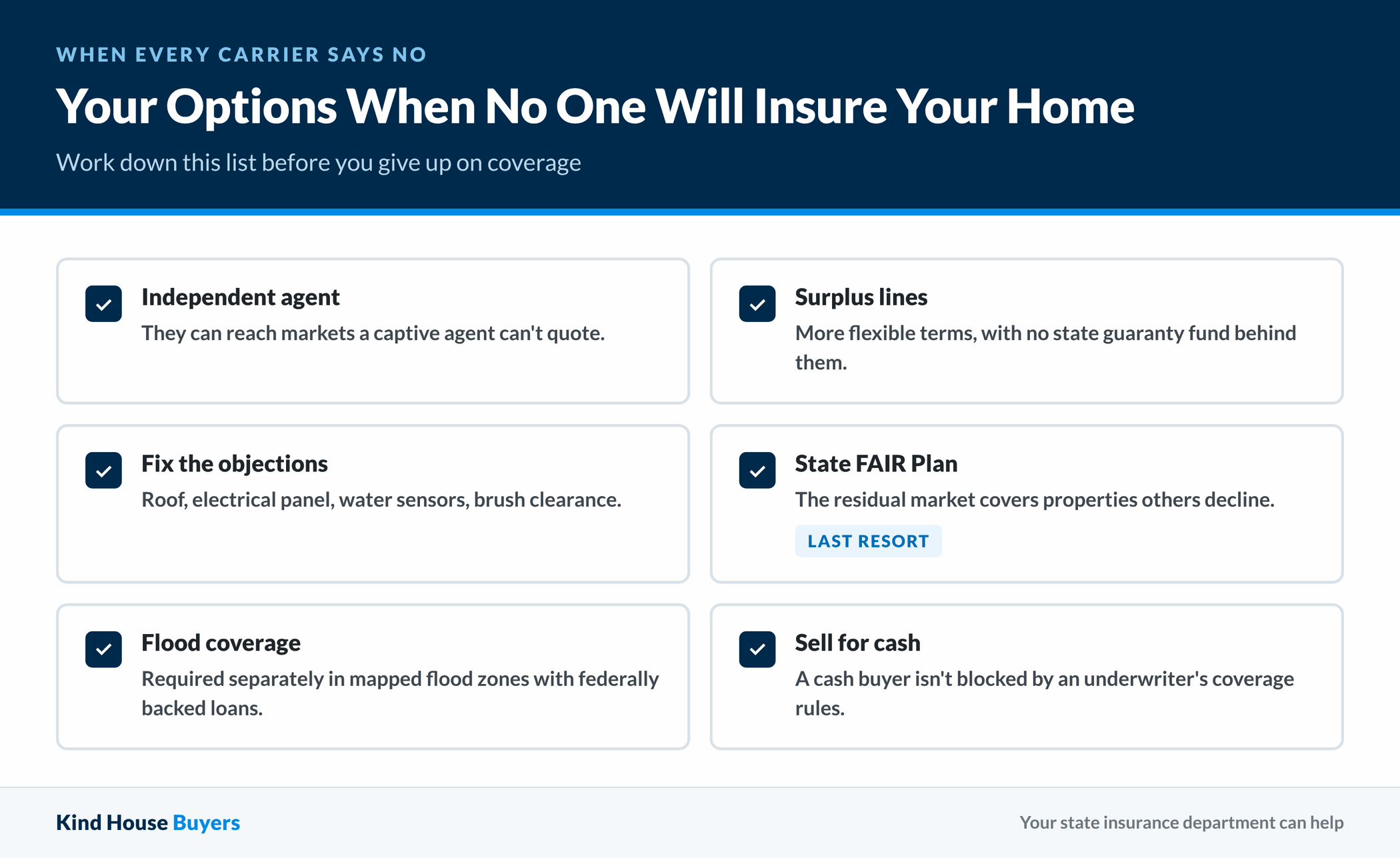
Every state’s residual market program works a little differently, but the premise is shared: carriers doing business in the state pool together to cover properties the voluntary market declines. Growth has been steep. California’s plan carried nearly 700,000 policies and $768 billion of exposure as of June 2026. The Texas FAIR Plan Association insured 118,486 properties as of June 30, 2026, per its quarterly fact book.
Surplus lines carriers are the other real source of homeowners insurance when the standard market says no. These insurers write risks admitted companies won’t touch, with more flexible terms and no state guaranty fund behind them. An independent agent who works with multiple wholesalers will find these; a captive agent generally can’t.
A new roof, updated electrical panel, water shutoff sensors, and brush clearance can move a declined property back into the standard market. Carriers in wildfire states increasingly reward documented mitigation work.
Mobile home owners should look at specialty manufactured-housing insurers rather than general carriers.
Selling is a legitimate option, not a defeat. If the premium exceeds what the house earns you, or the only policy available excludes the one peril your area faces, moving on is arithmetic. A homeowner in Erie, Pennsylvania called me after watching two agent listings expire back-to-back with not a single offer. She had a detached garage full of her late husband’s woodworking tools, and a carrier that had walked away from the whole county. Her house wasn’t the problem; financing it was. Teams like Kind House Buyers buy in that exact situation, and a cash close sidesteps the underwriting wall entirely.
Can You Face Legal Trouble for Skipping Homeowners Insurance?
Lose this one and you can lose the house itself, a consequence many people don’t attach to an unpaid premium.
No state prosecutes an owner for going without homeowners insurance. The risk is civil and contractual, and it moves through three channels.
Your mortgage comes first on the list. Default provisions sit in the deed of trust you signed, and failure to maintain hazard insurance is listed right alongside failure to pay. Servicers almost always force-place rather than accelerate, but acceleration is on the table.
HOA covenants are the second. Associations can assess fines and record liens against noncompliant units, and those liens cloud title until they’re satisfied.
Personal liability is the third and the one with no ceiling, so when someone’s injured on your property they sue you directly. Without homeowners insurance there’s no carrier to defend you, no settlement authority, and no payout; a judgment attaches to you personally, and depending on your state it may reach wages or other assets.
One misconception I’d like to kill: force-placed insurance does not protect you from a liability claim. That coverage answers the lender’s requirements and typically covers the dwelling alone, so if someone falls down your stairs, you’re on your own.
What if you disagree with a nonrenewal or a force-placed charge? File a complaint with your state’s insurance department, which regulates carrier conduct, and separately with the CFPB if the dispute involves your servicer’s handling of escrow or notices. Both routes are free.
Flood damage sits outside standard homeowners insurance everywhere in the country. If your parcel is in a mapped flood zone and your loan is federally backed, separate flood coverage is a legal requirement under federal lending rules. FEMA’s flood insurance program is where most of those policies originate.
Frequently Asked Questions About Homeowners Insurance Denials
What Should You Avoid Saying to a Home Insurance Adjuster?
Don’t speculate. Guessing at a cause (“the roof was probably already bad”), estimating damage dollar amounts you haven’t verified, or admitting partial fault all end up in the file and can shrink or sink your payout. Describe what you observed, hand over photos and receipts, and say you’ll follow up in writing when you don’t know something. Recorded statements are common, and you’re allowed to ask for the questions in advance.
How Much Would Coverage Run on a $400,000 Home?
The national figure cited earlier in this article is built on exactly that dwelling amount, so it’s a reasonable starting point. Your actual quote will swing hard based on state, roof age, claims history, deductible, and distance from a fire hydrant. Owners in the priciest states pay several times what owners in the cheapest ones do for identical homes, which is why shopping at least three carriers matters more than any single average.
What Should You Do When Every Carrier Turns You Down?
Work with an independent agent first, since they can reach surplus lines markets that captive agents can’t quote. Knock out whatever underwriting objections are fixable, especially roof and electrical. If those fail, your state’s residual market program has to take qualifying properties, and you can layer additional coverage on top of its bare-bones policy. Selling is a reasonable answer too when the ongoing cost outruns what the property is worth to you.
Does a Denied Claim Hurt You Later?
It can. Denied claims still get reported to industry claims databases, and future carriers see the inquiry even though nothing was paid. That’s why calling your agent to “just ask” about a small loss sometimes costs more than paying the repair yourself. Before you file, compare the likely payout against your deductible and the odds of a rate increase or a nonrenewal at your next term.
Can You Sell a House That Has No Insurance?
Yes, and people do it constantly. The limitation is financing: a buyer using a mortgage has to bind a policy before closing, so an uninsurable property narrows your pool to cash buyers and investors. Disclose the nonrenewal or denial honestly, because it will surface in the buyer’s own quoting process anyway.
Selling an Uninsurable House in Tacoma
Pierce County’s median sale price held at $560,000 in October 2026, and financed buyers there still need a bound policy to close. If an insurance problem is stalling your sale in Tacoma or elsewhere in Washington, we can make a cash offer that doesn’t depend on a lender’s coverage rules.
Talk With Kind House Buyers About an Uninsurable House
If you’re sitting on a house no carrier will write, or you’re tired of watching force-placed charges eat your escrow, we’re glad to talk it through. Tell us what’s going on with the property and we’ll give you a straight read on your choices, including the ones that don’t involve selling to us. No pressure, no obligation, and no cost for the conversation. You can reach out to Kind House Buyers or fill out the form below.