

A notice of trustee’s sale shows up in your mailbox, and suddenly a problem that felt manageable becomes very, very real. You’re behind on your home loan, the lender has started the clock, and you’re sitting there wondering if you’ve already run out of options. You haven’t. Sellers in Washington State successfully sell homes that are in foreclosure every single month. Many of them walk away with cash in their pocket. Move before that auction date closes in on you.
What You Need to Know Before Anything Else
One seller I worked with a while back inherited a house in Lacey after her father passed away. She was out of state, had never seen the property in person, and the mortgage was already four months behind when she called me. Her first instinct was to spend money on the kitchen. She’d gotten a contractor estimate that came in higher than the kitchen’s actual contribution to the sale price. She was ready to sign. We talked her out of it on a Thursday morning. She sold the house as-is, paid off the loan, and cleared enough to cover the estate costs. This is the pattern I see constantly with out-of-state heirs. The renovation reflex kicks in before the math does, and the math is rarely kind.
Foreclosure in Washington State moves through a non-judicial process, which means the lender doesn’t need a court order to proceed. Washington’s Deeds of Trust Act, codified as RCW 61.24, governs the process. Your lender works through a trustee, a neutral third party who manages the sale. Most homeowners can sell the property, pay off the debt, and keep whatever equity remains. That holds at any point before a trustee’s sale actually happens.
That window is finite. Pre-foreclosure is your selling window, and how you use it determines your outcome. Sitting on the decision while hoping something changes is how sellers lose both the house and any equity they’d built.
Can You Sell a House in Foreclosure in Washington State?
A homeowner who bought in Tacoma in 2019 and missed six months of payments may still be sitting on six figures of equity. Washington State’s median home price in June 2026 was $617,990, down 1.3% compared to the prior year. Even with modest price softening in some areas, most homeowners in foreclosure still have equity to protect, especially if they bought before 2022. That equity is why selling beats walking away. Once the bank takes the house, it doesn’t come back to you.
Yes, you can sell. Receiving a notice of default or even a notice of trustee’s sale does not strip you of ownership. You remain the owner of record until the trustee’s sale closes and the deed transfers to the highest bidder at auction. During that entire period, you can list the property on the MLS, negotiate with buyers, accept an offer, and close escrow. Your sale just has to generate enough to pay off the outstanding mortgage balance, any accrued fees, and applicable closing costs.
What complicates things is the presence of other liens. A second mortgage, unpaid property taxes, HOA dues, or a contractor’s lien recorded against the property all have to be addressed before title can transfer cleanly. A title search early in the process tells you exactly what you’re working with. Buyers and their lenders won’t close on a property with unresolved liens. Understanding your full debt picture before you list is not optional.
Many sellers do not know that deficiency judgments are not allowed following nonjudicial foreclosures in Washington. Let the property go to a foreclosure auction and the sale may not cover the full loan balance. Under a nonjudicial process, the lender generally cannot come after you personally for the difference. Knowing this matters. It doesn’t make walking away the better choice when you have equity sitting in the property.
How the Washington State Foreclosure Timeline Affects Your Selling Window
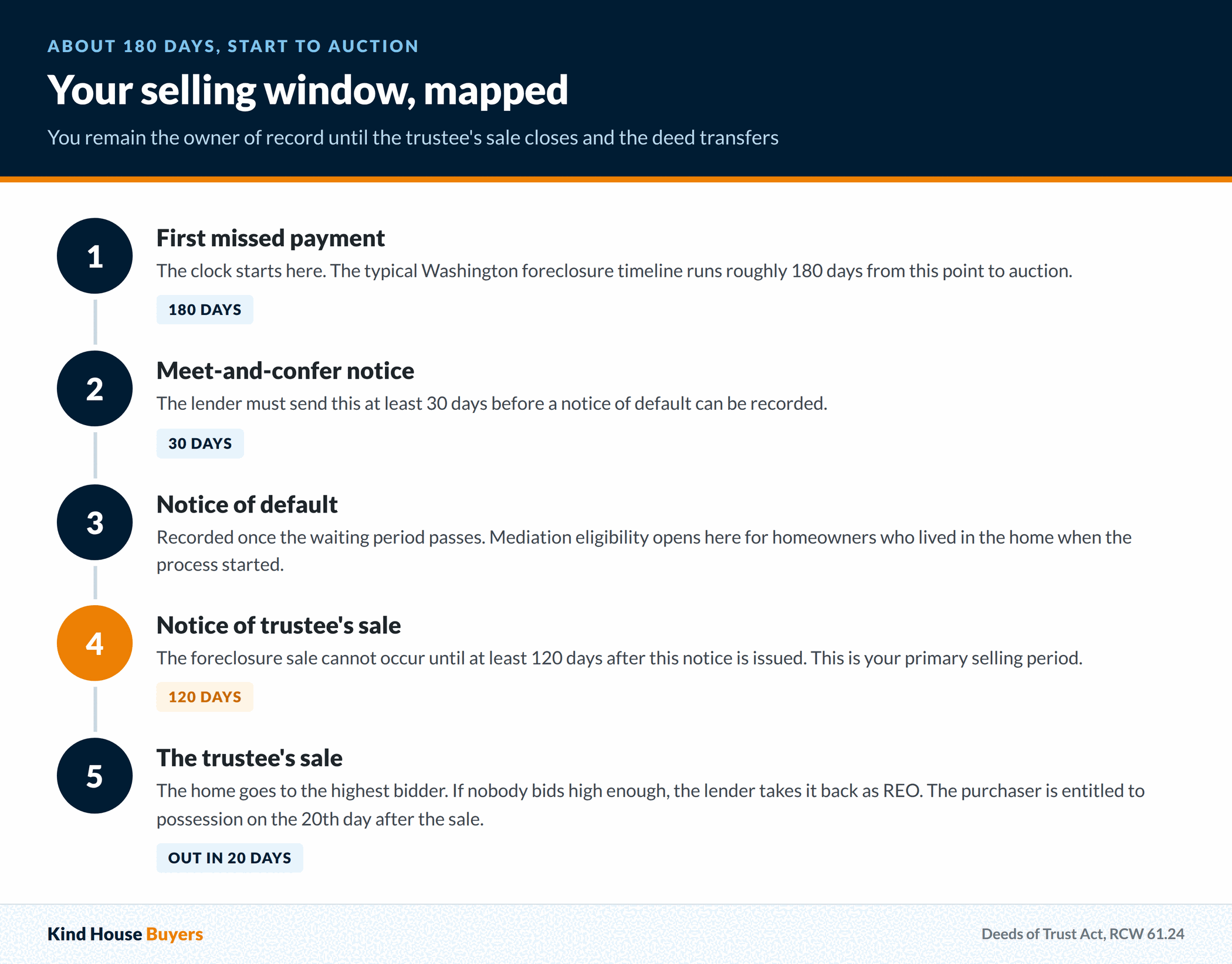
A homeowner with two months of missed payments feels like they have forever. Six weeks later, after a notice of trustee’s sale lands, they realize the auction date is circled on the calendar and they haven’t talked to a single buyer. Sellers lose their best options in the gap between having time and having very little of it.
The typical foreclosure timeline in Washington runs approximately 180 days from the first missed payment to auction. It sounds like a lot. In practice, it evaporates fast. Before a notice of default can be recorded, the lender must first send a meet-and-confer notice at least 30 days prior. Then comes the notice of trustee’s sale, and the foreclosure moves to its final stage. The foreclosure sale cannot occur until at least 120 days after that notice is issued.
Your primary selling period is the 120-day formal notice window, and it matters enormously. The median days on market in Washington State was 33 days as of June 2026. A traditional MLS listing could theoretically close within the window. Closing that close leaves no room for a sale falling through, a buyer’s financing collapsing, or a title issue that needs clearing. Every delay compounds the pressure.
Selling to a direct buyer rather than listing on the open market shrinks that timeline considerably. A cash buyer can often close in two to three weeks. That gives you time to sign a contract, clear the debt, and close escrow without scrambling. The sooner you start, the more leverage you have on price. Buyers can sense urgency if you wait.
Also worth knowing: foreclosed homeowners in Washington don’t get a redemption period after a nonjudicial foreclosure. Once the trustee’s sale closes, the property transfers immediately. There’s no coming back.
Washington State Foreclosure Mediation Program and How It Can Help
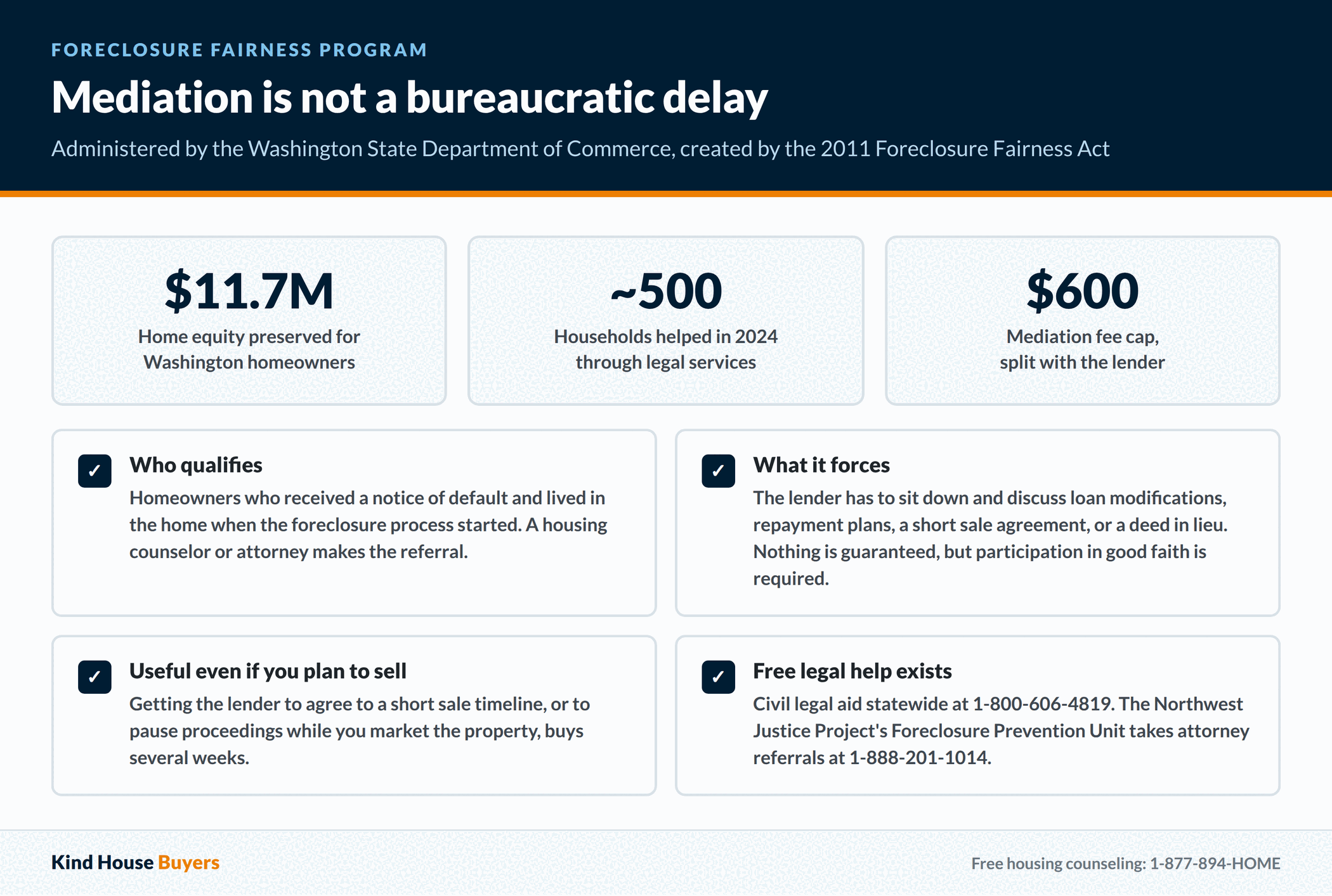
Some sellers assume mediation is just a bureaucratic delay with no real payoff. This assumption is wrong, and it’s costly to make without checking.
The Foreclosure Fairness Program is administered by the Washington State Department of Commerce. It provides free housing counseling, civil legal aid, and foreclosure mediation. The goal is to help homeowners and lenders explore alternatives to foreclosure and reach a resolution wherever possible. The program was created by the 2011 Foreclosure Fairness Act and it’s still active today. You can reach a free housing counselor any time by calling 1-877-894-HOME (4663), as listed on the Washington State Department of Financial Institutions’ foreclosure assistance page.
Homeowners may be eligible for mediation if two things are true. They received a notice of default from their lender, and they lived in the home when the foreclosure process started. A housing counselor or attorney refers you into the program, so you don’t navigate the entry process alone. If referred to mediation, the homeowner and lender split the mediation fees, which combined must not exceed $600.
What does mediation actually accomplish? It forces the lender to sit down with you and discuss alternatives. Loan modifications, repayment plans, a short sale agreement, or a deed in lieu of foreclosure. None of those outcomes are guaranteed, but lenders are required to participate in good faith. In 2024, nearly 500 households received legal advice or representation through the Foreclosure Prevention Legal Services program. Those services helped preserve more than $11.7 million in home equity for Washington homeowners. That equity disappears fast at auction.
If your goal is to sell rather than keep the home, mediation can still be useful. Get the lender to formally agree to a short sale timeline, or to pause proceedings while you market the property, and you buy several weeks. Those are weeks you’d otherwise be spending watching the auction date creep closer.
What Are Your Options to Sell a House in Foreclosure in Washington State?
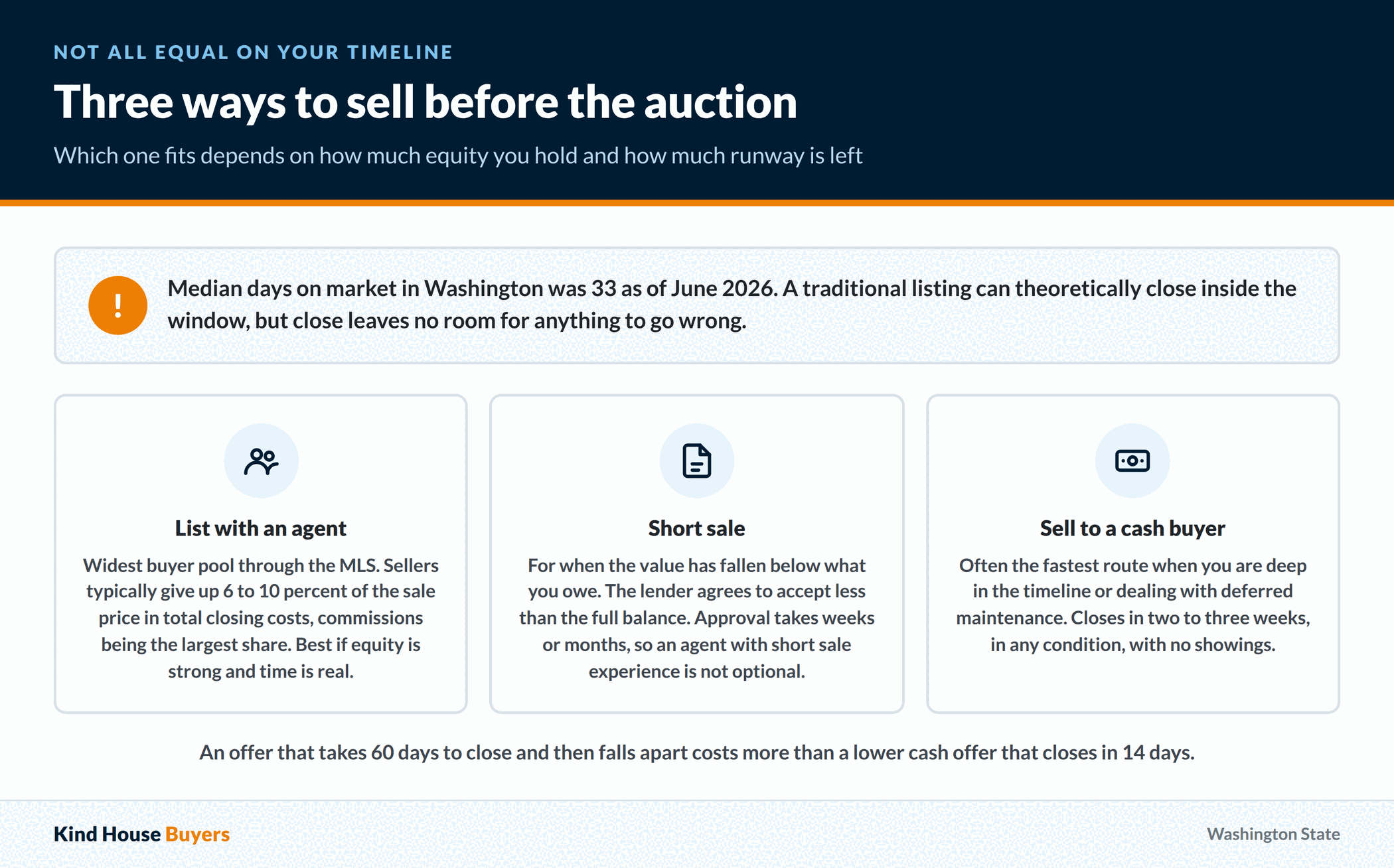
A Seattle homeowner facing a $340,000 notice of default typically pictures a single path. Find a real estate agent, list on the MLS, and hope a buyer materializes fast enough. That picture breaks down fast. A buyer needs 45 days to close. Financing falls through at the last minute. An inspection sends a traditional buyer running.
You have several distinct options, and they’re not all equal depending on your timeline and equity position.
Listing with a real estate agent or Realtor gives you access to the widest pool of buyers through the Multiple Listing Service. Sellers in Washington typically give up somewhere between 6 and 10 percent of the sale price in total closing costs. Agent commissions account for the largest share. On a median-priced home, that’s a real number. If you have strong equity and enough time on the foreclosure timeline, a traditional listing can net you the most money. If you’re tight on time, an offer that takes 60 days to close and then falls apart costs you more than a lower cash offer that closes in 14 days. I’ve watched that happen to sellers holding out for top dollar while the auction clock ran.
A short sale is the path when the property value has fallen below what you owe. Your mortgage lender agrees to accept less than the full balance to release the lien and let the sale close. Short sales require lender approval, and that approval process can take weeks or months. An experienced listing agent with short sale experience is non-negotiable here, not a bonus. The lender’s loss mitigation department won’t hold your hand through their own paperwork.
Selling directly to a cash buyer is often the fastest route. That goes for homeowners deep in the foreclosure timeline, those handling deferred maintenance, and anyone without the bandwidth for a traditional sale. Companies like Kind House Buyers buy properties in any condition, in pre-foreclosure or active foreclosure, without requiring repairs, showings, or open houses. The offer runs below retail. The speed and the certainty of closing often outweigh the price difference when the auction date is approaching and you’re counting days, not weeks.
How to Determine Market Value and Net Proceeds Before You Sell
Pricing a pre-foreclosure home based on gut feel is how sellers leave equity on the table or price themselves out of a fast sale entirely.
A comparative market analysis from a licensed real estate agent gives you a grounded picture of what buyers are paying for similar properties in your area right now. Homes in Tacoma, Kennewick, and Spokane carry very different price points than properties in Bellevue or Redmond. Even within a single city, neighborhood differences matter. Pullman looks nothing like Puyallup. School districts alone shift the numbers, and the comps reflect that.
Beyond the sale price, you need to know your net. Add up your current mortgage payoff amount, any second mortgage balances, unpaid property taxes, HOA dues, and recording fees. Call your servicer for the exact 10-day or 30-day payoff figure. Then subtract your anticipated selling costs. Closing costs in Washington, excluding agent fees, run around 2.5 to 3.6 percent of the home’s sale price. That’s higher than many states, partly because of Washington’s real estate excise tax. The state excise tax is graduated. As of January 1, 2025, sales up to $525,000 are taxed at 1.1%. Sales between $525,001 and $1,525,000 are taxed at 1.28%. Sales between $1,525,001 and $3,025,000 are taxed at 2.75%, and sales above $3,025,000 at 3.0%. Local REET adds on top of that in most cities and counties.
What’s left after the debt, the fees, and the taxes is your actual take-home. If that number is positive, selling beats foreclosure almost every time. If it’s zero or negative, a short sale or direct negotiation with the lender may be the more realistic path.
What to Repair, Improve, or Leave Alone When Selling a Foreclosure Home
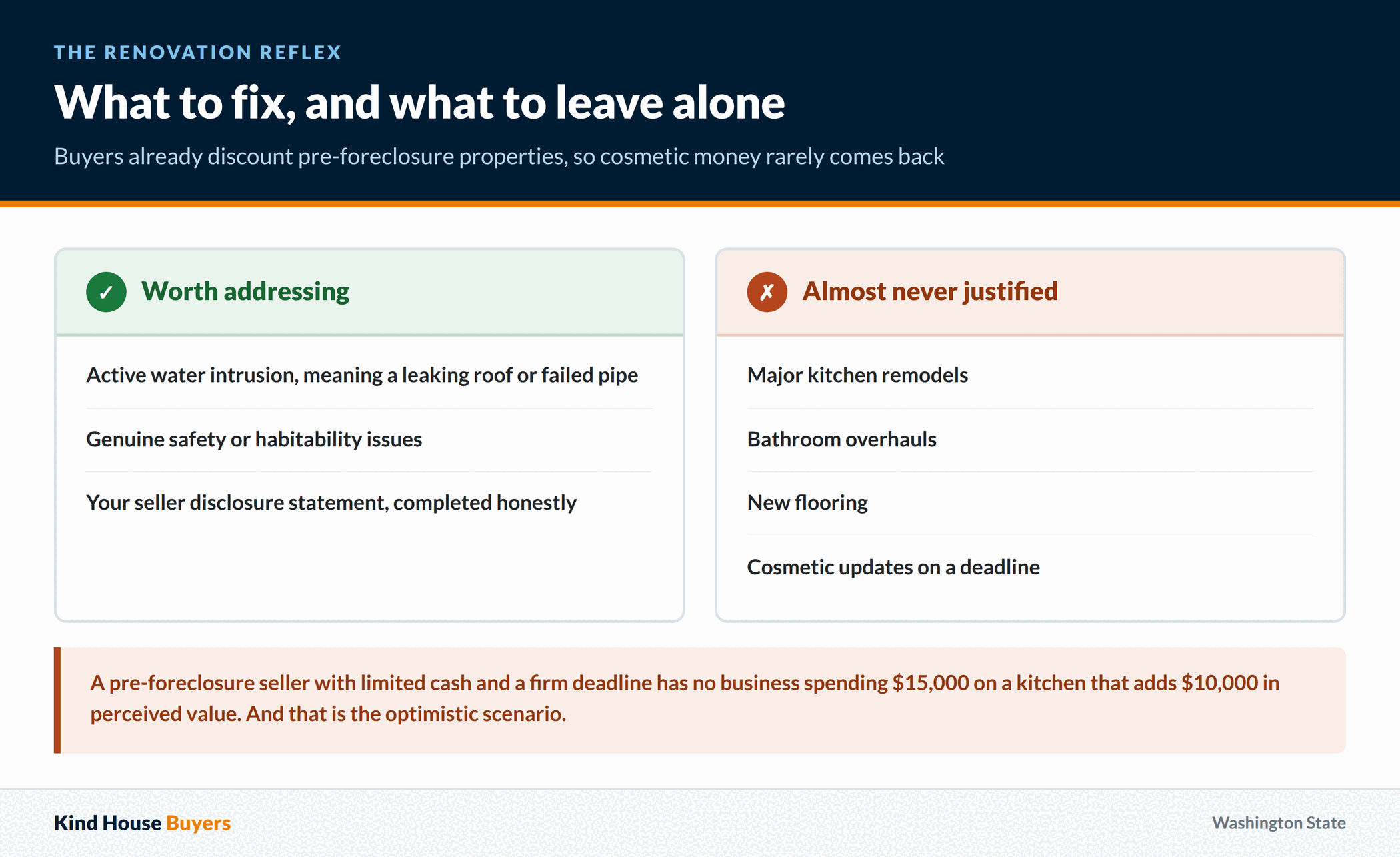
Maintenance debt and mortgage debt tend to travel together. A roof that’s been leaking into the attic for two years, a furnace that runs but probably shouldn’t, and deferred yard work are common. What most articles skip is simple. Buyers already discount pre-foreclosure properties, so spending money on cosmetic fixes rarely earns it back.
There’s a short list of things worth addressing. Active water intrusion, meaning a leaking roof or a failed pipe, should be disclosed. If the cost is manageable, stop it before listing. Buyers who see fresh water damage during a walkthrough either walk out or demand a credit far larger than the repair would have cost. Beyond genuine safety or habitability issues, the math on repairs rarely works in your favor when you’re racing a trustee’s sale date.
Major kitchen remodels, bathroom overhauls, and new flooring are almost never justified. A pre-foreclosure seller with limited cash and a firm deadline has no business spending $15,000 on a kitchen that adds $10,000 in perceived value. That’s the optimistic scenario. The numbers don’t lie, and experienced buyers know that as well as any appraiser would.
Selling as-is is frequently a legitimate and smart choice. Kind House Buyers buys homes in as-is condition across Washington State. No negotiating repair credits, no worrying about a buyer’s inspector flagging every deferred item, no spending money you don’t have before closing. The offer accounts for the property’s condition, and you know exactly what you’re walking away with before you sign anything.
What you absolutely must do is disclose. Washington sellers are required to complete a seller disclosure statement. Hiding known defects from a buyer opens you up to liability well after closing.
Mistakes That Close Your Selling Window Faster Than You Expect
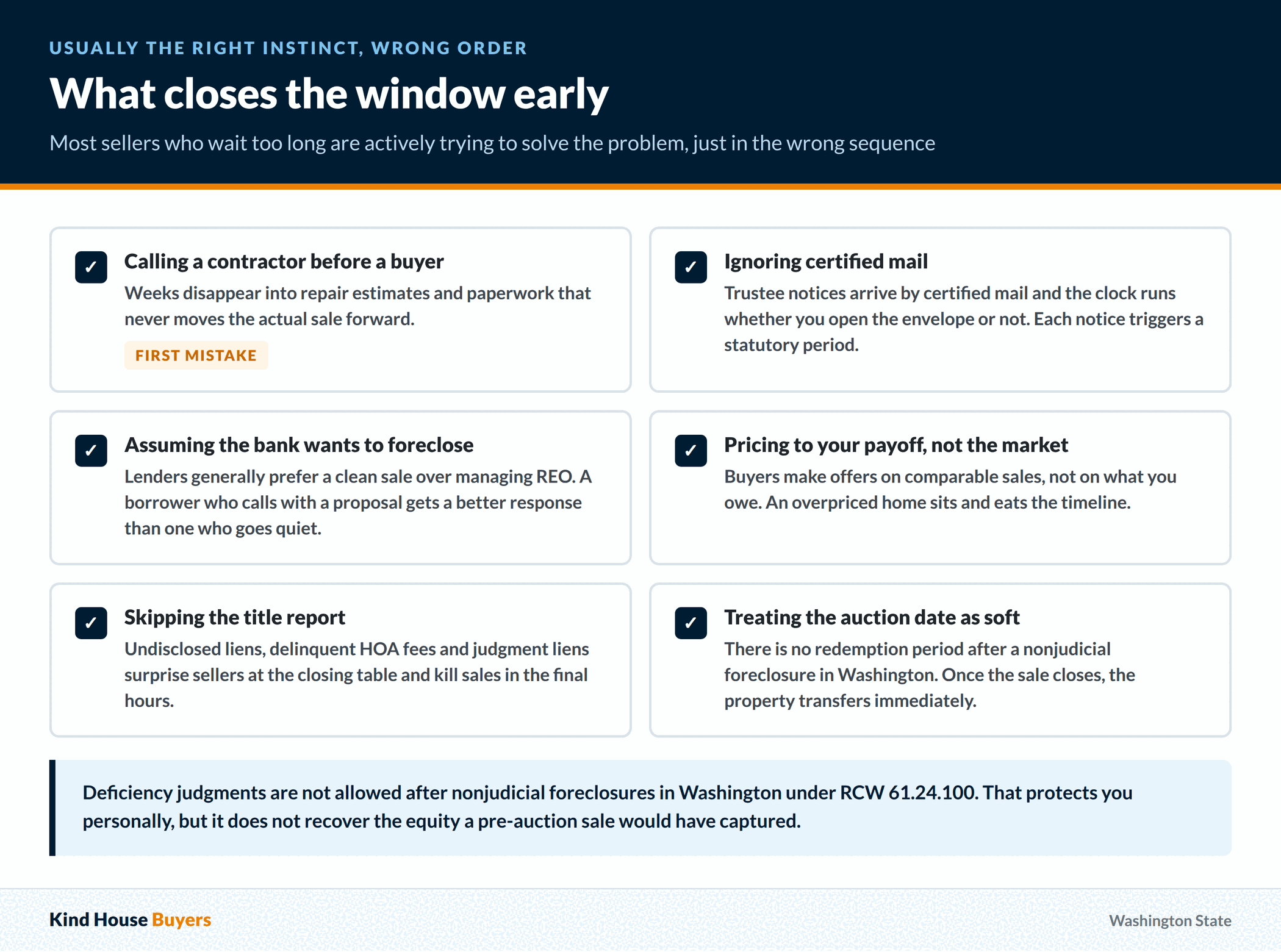
I used to think that sellers who waited too long were just in denial. Turns out, a lot of them are actively trying to solve the problem, just in the wrong order.
The first mistake is contacting a contractor before contacting a buyer. Weeks disappear into repair estimates, lender calls, and paperwork that doesn’t move the needle on the actual sale.
Ignoring certified mail is next. Notices from the trustee arrive by certified mail, and the foreclosure clock runs whether you pick up the envelope or not. Every formal notice triggers a statutory period, and missing those deadlines costs you options you cannot get back.
Assuming the bank wants to foreclose is another one. Lenders generally prefer a clean sale over managing REO inventory. A borrower who calls proactively, explains the situation clearly, and proposes a solution gets a better response. A sale date, a short sale agreement, a payment plan. Far better than ghosting the servicer until the trustee’s sale is a week out.
Overpricing the home because you “need” a certain number to break even is perhaps the most common error. The market does not care what you owe. Buyers make offers based on comparable sales, not on your mortgage payoff amount. A home priced above market will sit and collect days on market. It eats through your remaining timeline while buyers move on to properties priced where they should be.
Finally, trying to sell without reviewing your title early. Undisclosed liens, delinquent HOA fees, and unresolved judgment liens routinely surprise sellers at the closing table. A sale you thought was done falls apart in the final hours. Get a preliminary title report before you accept any offer.
What Happens If the Trustee’s Sale Date Arrives Before You Sell?
Miss that auction date without a closed sale or a postponement in hand, and you no longer own the property. Full stop.
At the trustee’s sale, the home is offered to the highest bidder at public auction. If no third-party buyers bid high enough, the lender takes the property back as REO. In Washington, the purchaser is entitled to possession of the home on the 20th day after the foreclosure sale. That means you need to be out. Quickly.
The sale can sometimes be postponed. That requires either the trustee agreeing to delay, typically at the lender’s direction, or a court order. If you have a signed purchase agreement for the sale and an imminent closing date, contact the trustee directly and ask for a postponement. Bring documentation. Verbal assurances don’t stop an auction.
One partial protection: deficiency judgments aren’t allowed following nonjudicial foreclosures in Washington under RCW 61.24.100. Even if the auction doesn’t cover the full balance, you won’t owe the difference personally in most standard deed-of-trust situations. That’s a meaningful protection. It doesn’t recover the equity you would have captured with a pre-auction sale. The auction is a hard stop. Treating it that way from the beginning is what separates sellers who keep their equity from sellers who don’t.
Alternatives to Foreclosure Worth Considering in Washington State
What if selling feels like giving up, but you also know you can’t keep the mortgage going?
A loan modification through your servicer restructures the terms of your existing home loan. That can mean a lower interest rate, a longer repayment period, or missed payments moved to the back end. Servicers are generally required to evaluate you for loss mitigation options before proceeding with foreclosure. Asking directly puts that in motion.
Your payments are paused or reduced temporarily through a forbearance agreement. This doesn’t erase the debt. The missed amounts still accrue and eventually have to be repaid. It can provide breathing room, though, when a temporary hardship has put you behind and your underlying finances are otherwise stable.
A deed in lieu of foreclosure lets you sign the property over to the lender voluntarily rather than going through the full trustee’s sale process. Lenders don’t always accept them, especially where junior liens won’t be wiped out automatically. It can sometimes be negotiated as a cleaner exit for both sides.
Renting the home while working on a longer-term sale plan is an option some borrowers overlook. A tenant paying rent doesn’t solve the default, but it can generate income to fund a loan reinstatement or buy time to market the property properly.
Where to Find Legal Assistance for Foreclosure Help in Washington State
Speaking with a foreclosure attorney before making any decisions isn’t a luxury. It’s the kind of move that saves homeowners from signing agreements they don’t fully understand or missing a statutory protection they didn’t know existed.
A landlord I worked with in Gig Harbor had been quietly carrying two mortgages for almost a year. The original home loan, plus a HELOC on a rental property he’d stopped renting out. By the time he reached out on a Saturday, he’d already received a notice of trustee’s sale on the rental and hadn’t told anyone about it. The garage was still full of the tenant’s belongings from the previous lease. Once we sorted out the timeline, there was enough runway left. Sell the rental, cover both liens, and bring the foreclosure process to a full stop. Had he waited another six weeks, the window would have closed. He later said talking to an attorney in week one would have cut the stress in half.
The Foreclosure Fairness Program at the Washington State Department of Commerce provides free housing counseling, civil legal aid, and foreclosure mediation. Low and moderate-income homeowners can contact the statewide civil legal aid program at 1-800-606-4819 or visit www.nwjustice.org/get-legal-help.
Oversight of the foreclosure mediation program sits with the Washington State Department of Financial Institutions, which also provides referral information. The Northwest Justice Project’s specialized Foreclosure Prevention Unit provides legal services under the Foreclosure Prevention Legal Services program. Their toll-free number for attorney referrals is 1-888-201-1014.
Private real estate attorneys who focus on distressed property and foreclosure defense are also an option. On average, attorneys charge around $361 per hour in Washington. A one-hour consultation can clarify your rights, your timeline, and your options before you commit to any path. If you’re also weighing a cash sale, a company like Kind House Buyers can walk through the numbers with you directly, without any obligation. Then you’re comparing real options rather than guessing.
Frequently Asked Questions
How Long Does the Foreclosure Process Take in Washington State?
The typical timeline from a first missed payment to auction runs approximately 180 days in Washington State. That includes a mandatory meet-and-confer period, the notice of default, and a 120-day formal notice period after the notice of trustee’s sale is recorded. Lenders don’t always move at maximum speed, so some timelines run longer, but you should not count on that buffer.
Can a Homeowner Sell a House That Is in Foreclosure?
Yes. As long as the trustee’s sale hasn’t occurred yet, you retain ownership and the legal right to sell the property. The proceeds must cover your outstanding mortgage payoff, any other liens recorded against the property, and applicable closing costs. Whatever remains after those obligations is yours to keep. Acting early gives you the most options and the most time to find a buyer at a fair price.
What Closing Costs Do Sellers Pay in Washington State?
This state charges a graduated real estate excise tax on sellers, ranging from 1.10% to 3.00% depending on the sale price. Local REET adds another 0.25% to 0.50% in most jurisdictions. On top of that, sellers typically pay title fees, their share of escrow, and any agreed-upon agent compensation. If you’re using a traditional listing agent, total seller costs commonly run between 6% and 10% of the sale price when commissions are included.
Do I Have to Pay Taxes If I Sell My House in Washington State?
Washington State does not have a personal income tax, so capital gains from a home sale aren’t taxed at the state level the way they are in many other states. You will owe Washington’s real estate excise tax at closing, as described above. Federal capital gains taxes may still apply. It depends on how long you owned the home and whether you meet the IRS primary residence exclusion criteria. A tax professional can tell you exactly where you stand based on your specific situation.
If you want to talk through your options, we’re here. No pressure, no obligation. A lot of the homeowners who reach out just want to understand their numbers before deciding anything. That’s completely fine. Reach out to Kind House Buyers whenever you’re ready.
Pre-Foreclosure Sales Around Tacoma
Tacoma is where we buy most often, and pre-foreclosure calls are a steady part of the week. The typical Tacoma home value was $496,203 as of July 31, 2026, close to flat over the year. Flat values mean the equity you have is the equity you have, and no rising market is going to quietly bail out a missed-payment problem. That makes the timeline the whole game.
We buy across the region, including Lakewood, Federal Way, Auburn, Kent, Olympia, and Puyallup. Our how it works page shows how a closing gets scheduled around a trustee’s sale date.
Call Before the Date Gets Close
The single most useful thing you can do is find out where you actually stand, early, while you still have choices. Sometimes that means we buy it. Sometimes it means mediation or a listing gets you more, and we will say so. What does not help anyone is finding out in week twenty-two that week six was when the good options were on the table.
You can read common questions for Kind House Buyers if you would rather look first. When you want your numbers run against the auction date, contact us. No cost, no obligation, and no pressure to sell to us. The short form below reaches us directly.
Sell your Washington house without a Realtor 75% Faster
No Hidden Fees or Commissions. Sell Your House As-Is And Close On The Day Of Your Choice. Fill Out The Form Below.