

Now I have all the data I need. Let me write the complete article.
Moving out of state while your house still sits in Tacoma, Olympia, or somewhere along the I-5 corridor is rough. It’s one of the more stressful financial situations a homeowner can face. Two mortgages, or a mortgage on a house you’ve already left, eats equity fast. Good news for Washington sellers is that they have more options than most people use. Which path is right for you depends on three things. Your timeline, your property’s condition, and how much runway you have before the money gets tight.
Selling While Relocating Isn’t as Complicated as It Sounds
A lot of sellers I talk to assume that being out of the area means they’re at a disadvantage. They think buyers will sense the urgency and lowball them, or that coordinating showings from Phoenix or Denver is impossible. Those concerns have merit, but they’re not inevitable.
Not long ago I worked with a couple in Kenmore, a suburban community just north of Lake Washington. They were splitting up and dividing assets in a divorce. They needed the sale handled cleanly, quickly, and with as little back-and-forth as possible. The garage still had both of their bikes hanging on the wall. Neither of them could agree on who was coming back to clear it out. We bought the house as-is on a Thursday. They each got their share of the equity, and neither had to set foot in that garage again. The relief you could hear in their voices when we closed was something I won’t forget. Relocation sales can work the same way: with the right buyer or the right strategy, distance becomes manageable.
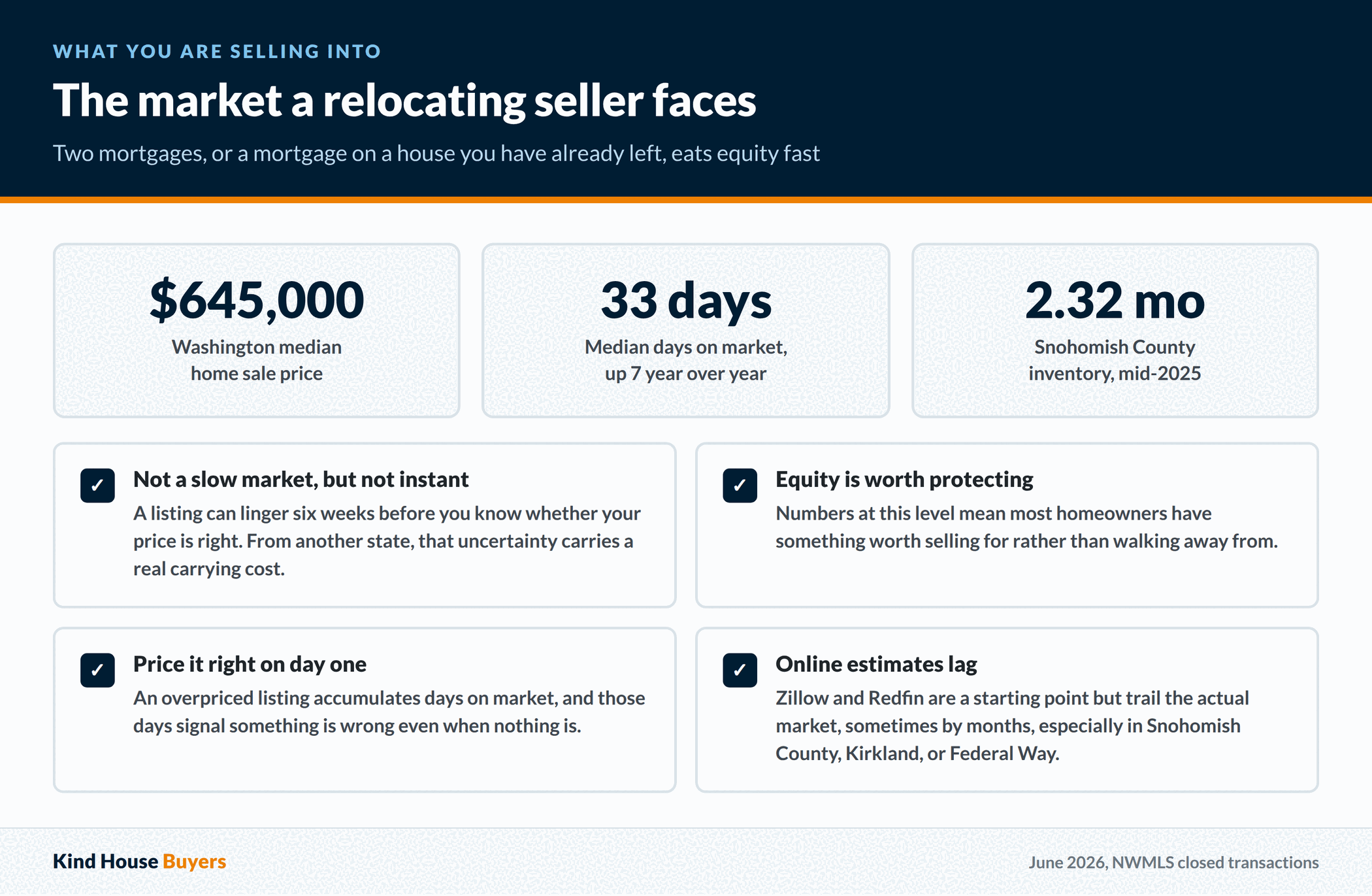
The market itself isn’t fighting you either. The median home sale price in Washington State was $645,000 as of June 2026, based on closed residential transactions reported through NWMLS. Strong numbers like this mean most homeowners have equity worth protecting, not walking away from.
What Is the Best Way to Sell a House in Washington State?
Pricing it right from day one beats every other strategy, period.
Sellers routinely hear that they should list high and leave room to negotiate. That advice costs them weeks on market and ultimately a lower sale price. Buyers in Bellevue, Redmond, and Tacoma are looking at price-per-square-foot data before they ever schedule a showing. An overpriced listing accumulates days on market. Those days signal something is wrong even when nothing is. I’ve watched clean properties sit for that exact reason.
Your two main routes are a traditional agent-assisted listing or selling directly to a cash buyer. The listing route makes sense if your home is in solid condition, you have time, and you’re in a neighborhood with strong comparable sales. Cash buyers, including companies like Kind House Buyers, make sense in three situations. A compressed timeline. A home that needs work. Or no realistic way to manage the coordination from another state.
The median days on the market in Washington was 33 days as of June 2026, up 7 days year over year. By national standards that isn’t a slow market. It does mean a listing can linger for six weeks before you know whether your price is right. For someone already living out of state and paying on both ends, that uncertainty carries a real cost. I’ve watched it quietly drain sellers who underestimated the carrying timeline.
A third option that’s often overlooked: selling to a neighbor or someone already in your social network before you ever hit the MLS. It skips the showings, the staging, and the open houses, which means you avoid the whole production of getting the place ready for strangers. Not always possible, but worth making a few calls first.
How Do You Figure Out Your Home’s Market Value and Net Proceeds in Washington State?
Sellers often go into the process expecting to walk away with whatever their neighbor got six months ago. That figure doesn’t account for what you actually owe, what it costs to sell, or what the market has done since then.
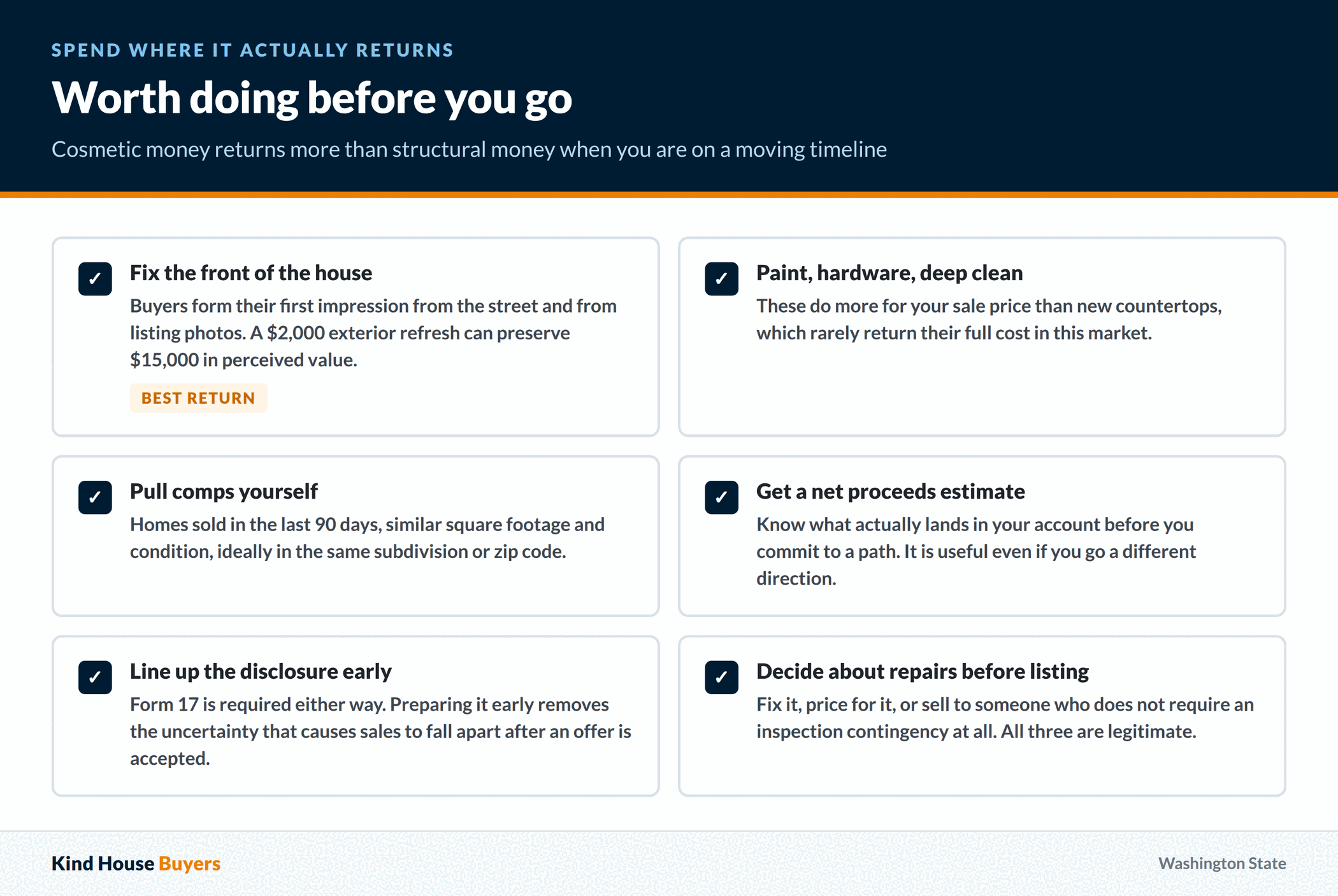
Getting your home’s market value right starts with a comparative market analysis, which any licensed real estate broker or agent can run for free. You’re looking at homes that sold within the last 90 days, similar square footage, similar condition, and ideally within the same subdivision or zip code. Online estimates from Zillow or Redfin are a starting point. They tend to lag the actual market, sometimes by several months, especially in fast-moving areas like Snohomish County, Kirkland, or Federal Way.
Your check at closing starts with the sale price. Subtract your remaining mortgage balance, your closing costs, agent commissions if applicable, and the Washington State Real Estate Excise Tax. What’s left is your check at closing, and for most sellers the gap between gross sale price and net proceeds is wider than they expected. Running this number before you list prevents the shock of seeing a much smaller figure on your final settlement statement.
Kind House Buyers can walk you through a rough net proceeds estimate at no cost. That’s useful even if you go a different direction. No pressure, just math.
What Are the Common Costs of Selling a House in Washington State?
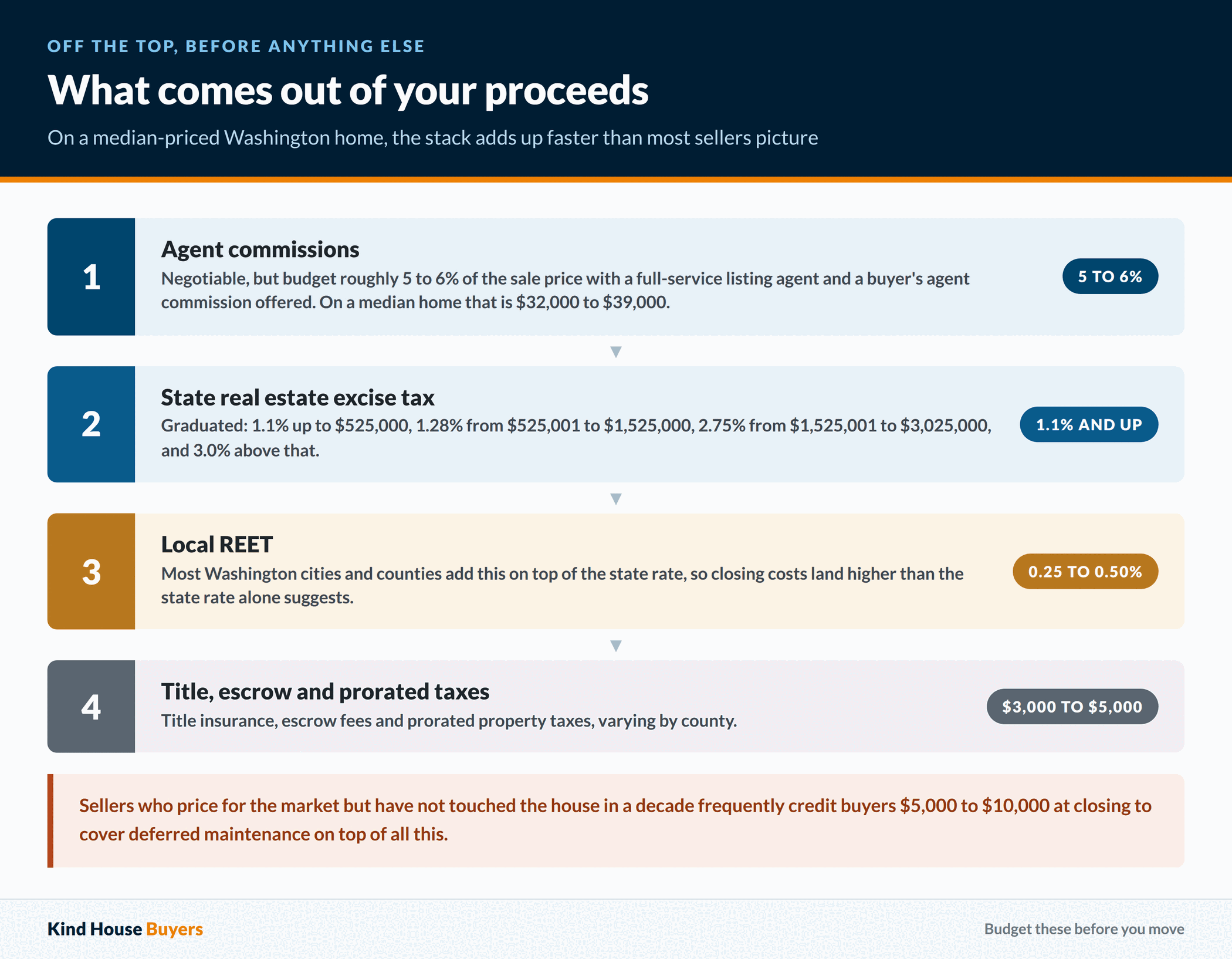
Washington uses a graduated REET structure. It runs 1.1% on the portion up to $525,000 and 1.28% from $525,001 to $1,525,000. From there it is 2.75% from $1,525,001 to $3,025,000, and 3.0% on amounts above $3,025,000. That’s the Real Estate Excise Tax, and it’s the line item on your closing statement that most sellers don’t notice until closing day.
On a home at the state’s current median price, the REET alone runs several thousand dollars before you’ve paid a single other fee. Most Washington cities and counties add a local REET of 0.25 to 0.50% on top of the state rate. Your closing costs land higher than the state rate alone suggests. King County and Snohomish County sellers should factor in that extra local layer as well.
Agent commissions are negotiable. Budget roughly 5 to 6% of your sale price if you’re using a full-service listing agent and offering a buyer’s agent commission. On such a home, that’s $32,000 to $39,000 off the top before anything else. Title insurance, escrow fees, and prorated property taxes usually add another $3,000 to $5,000 depending on your county.
One cost that often gets forgotten: any repairs or credits you agree to after the buyer’s inspection. Some sellers price for the market but haven’t touched anything in a decade. They frequently end up crediting buyers $5,000 to $10,000 at closing to cover deferred maintenance. Know what’s coming before you’re under contract. Then you can decide whether to fix it, price for it, or sell to someone who doesn’t require an inspection contingency at all.
What Should You Repair, Improve, or Leave Alone Before Listing?
Fresh exterior paint gives you a better return than almost any interior renovation, and most sellers never think to ask why. Buyers form their first impression from the street and from listing photos. Peeling paint or a tired front door kills both. Faded trim reads as neglect fast. A $2,000 exterior refresh can preserve $15,000 in perceived value.
Inside, focus on what buyers open and turn on: faucets, light switches, cabinet doors, and appliances. Anything that sticks, drips, or flickers during a showing creates doubt. Buyers start wondering what else doesn’t work.
New carpet rarely earns back what you spend on it. By the time you pay for materials and installation, buyers will still want to put their own flooring down. If the carpet is stained or worn, get a quote, and then offer a flooring credit instead. You’ll spend less and buyers feel like they got something.
Skip the full kitchen renovation. Cosmetic updates do more for your sale price than new countertops. New hardware, a coat of paint on the cabinets, a deep clean. Countertops rarely return full cost in this market. Bathrooms are similar: grout, caulk, and cleaning matter more than a gut remodel (and buyers notice grout immediately).
If the home needs a new roof, electrical panel, or HVAC system, get the repair done or price the home to account for it. Prospective buyers will find it in the inspection anyway, and at that point you’re negotiating from a weaker position (usually with less time on your side).
What Problems and Defects Do You Have to Disclose to Buyers in Washington State?
Sit down with me at a kitchen table and I’ll tell you this plainly: disclose everything you know. Not just the big stuff. The leak you patched in 2019, the outlet in the garage that trips the breaker, the neighbor’s drainage that pushes water toward your fence line in February. All of it.
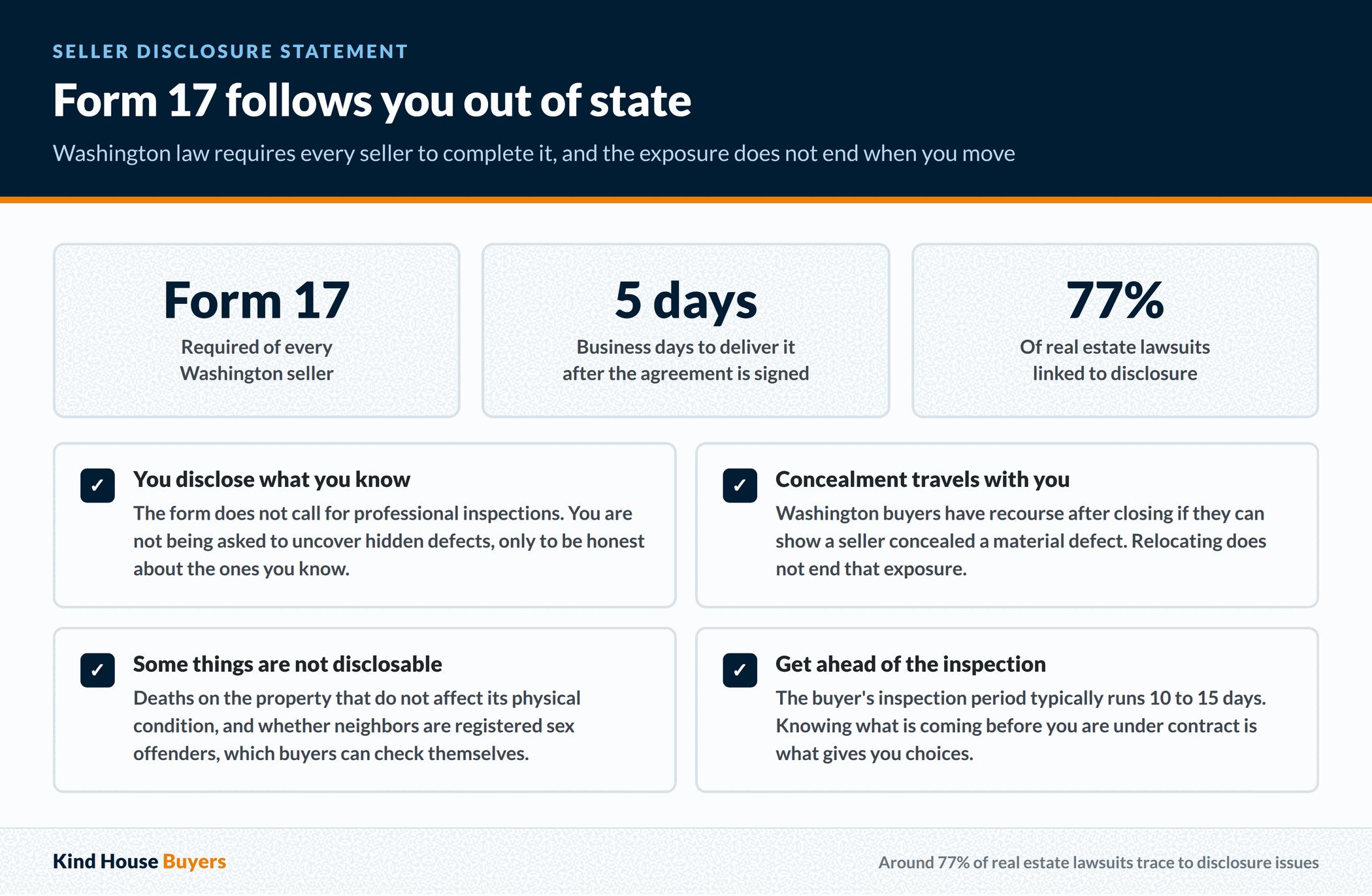
Washington law requires every seller to complete a Seller Disclosure Statement, known as Form 17. The form does not call for professional inspections, but it does require honest answers about problems you already know. Note the word “know.” You’re not being asked to uncover hidden defects; you’re being asked to disclose what you’ve seen and experienced in the house.
The seller’s disclosure must be given to the buyer no later than 5 business days after the purchase agreement is accepted (fully signed by both buyer and seller). That’s a statutory deadline under RCW 64.06, so don’t let it slip.
Around 77% of real estate lawsuits are linked to disclosure issues. Sellers who try to hide a known problem rarely save money; they transfer the problem forward and add attorney fees to it. Washington buyers have recourse after closing if they can show the seller concealed a material defect. That exposure doesn’t go away just because you’ve relocated to another state.
Some things you don’t have to disclose. Deaths on the property that don’t affect its physical condition. Whether neighbors are registered sex offenders, since buyers can check public databases for that. Similar stigmatized but non-material facts. Your real estate attorney can clarify the line if you’re unsure.
What Does Selling a House “as Is” Mean in Washington State Real Estate?
A landlord in Spanaway called me after his tenants moved out and left the place in rough shape. The carpet was gone in two rooms, there was a hole in the drywall near the back bedroom, and the backyard had become a storage lot for broken appliances. He’d already gotten two bids from contractors that totaled more than his equity cushion, and he didn’t have time to manage a renovation from where he lived.
Selling as-is was the right call. It didn’t mean he waived disclosure requirements; he still filled out Form 17 honestly. What it meant was that he listed the home at a price that reflected its condition and made clear that he wouldn’t be making repairs based on the buyer’s inspection.
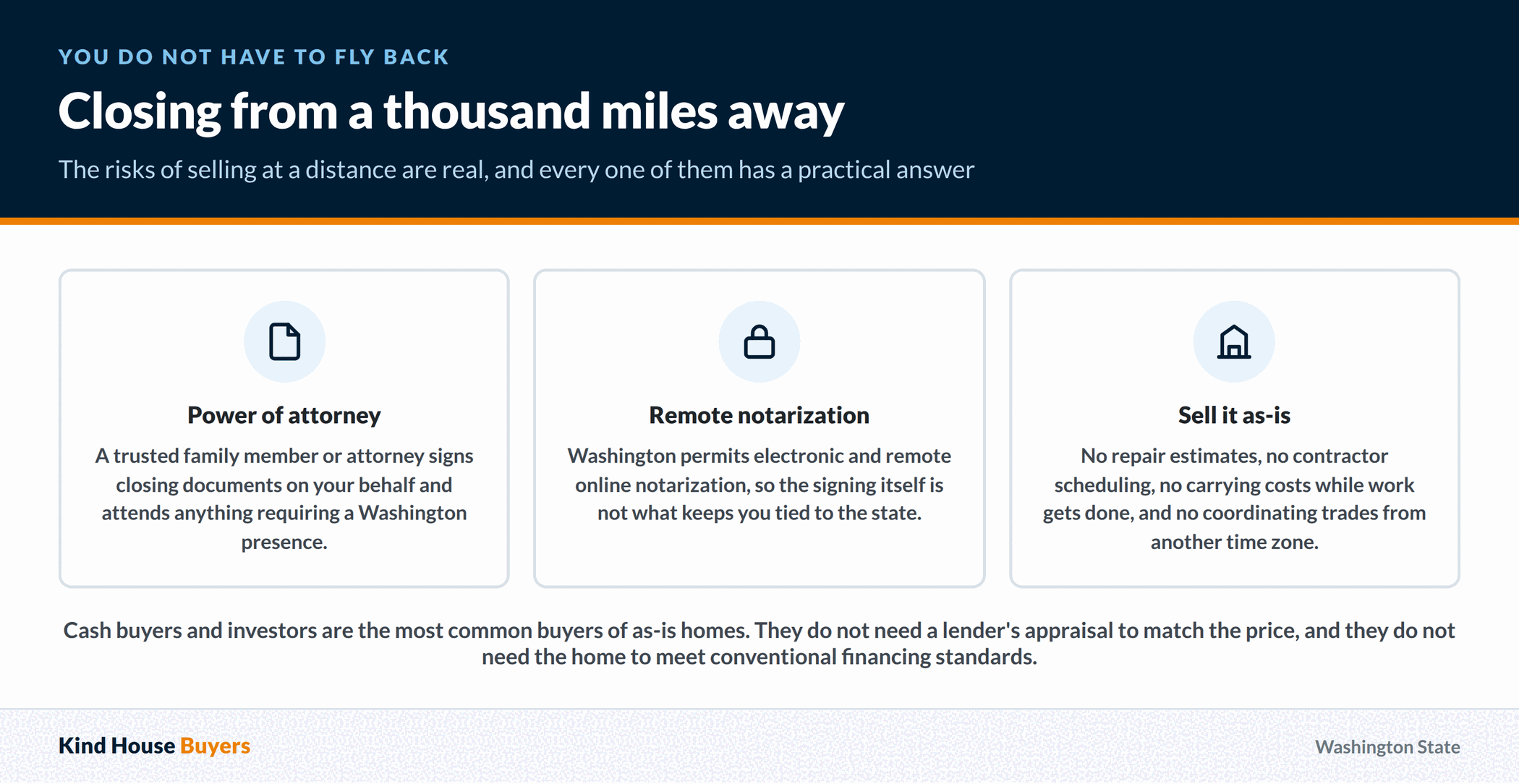
Buyers in an as-is sale can still inspect the home. They can still walk away if they don’t like what they find. What they agreed to upfront is that the seller isn’t going to credit or repair. That’s the whole arrangement. Cash buyers and investors are the most common buyers of as-is homes. They don’t need a lender’s appraisal to match the purchase price, and they don’t need the home to meet conventional financing standards.
Kind House Buyers buys homes in as-is condition across Washington State. You skip the repair estimates, the contractor scheduling, and the carrying costs while the work gets done.
Which Types of Homes Are Typically Sold As-is in Washington State?
Misjudge whether your property needs the as-is route and it costs you either way. Leave money on the table if the home is in good shape, or burn time and equity listing a problem property at retail and watching it sit.
Homes that move fastest through the as-is channel share a few characteristics. Deferred maintenance is the most common: roofs past their useful life, aging HVAC systems, outdated electrical panels, and foundation repairs that haven’t been addressed. Buyers using conventional loans through Fannie Mae or Freddie Mac often can’t finance a home with significant structural issues, which eliminates a large portion of the buyer pool.
Estate properties are another frequent as-is sale. When an heir inherits a home in Auburn or Puyallup that’s been sitting since a parent passed, they rarely have the time, the budget, or the emotional bandwidth to fix it up. Selling to a cash buyer lets the estate close quickly and distribute proceeds.
Rental properties with tenants in place are also common candidates. Coordinating a retail listing around an occupied rental, especially one with uncooperative tenants, is a headache most sellers would rather avoid. A cash buyer will take the property with the tenants in place and handle that transition themselves, sparing the seller from playing landlord through a drawn-out closing.
Properties in areas with strong investor interest, like parts of South Seattle, the Hilltop neighborhood in Tacoma, or pockets around Olympia, move quickly as-is because the buyer pool is active and experienced.
How Do You Build Buyer Demand Before You Evaluate Offers?
Are you listing your home, or are you marketing it?
Most sellers think listing IS marketing. It’s not. Putting a home on the MLS is the starting point, not the strategy. Real buyer demand gets built in the days before your home goes live on Redfin and Zillow.
Professional photography is non-negotiable if you’re doing a traditional listing. Scrolling through dozens of homes on their phones, buyers will skip past your home if the photos are dark or blurry before anyone reads the description. Video walkthroughs and 3D tours have become standard in the Seattle metro and Eastside markets, and they’re especially useful when you’re marketing to out-of-state buyers who may not visit until they’re under contract.
Getting your own inspection done before you list, and making the report available to buyers, removes the uncertainty that causes sales to fall apart after an offer is accepted. Full price becomes far more likely when buyers know exactly what they’re getting.
Price your home at a figure that invites multiple offers rather than one that filters buyers out. In markets like Snohomish County, which had roughly 2.32 months of inventory in mid-2025, a well-priced, well-presented home still draws competitive attention. Multiple offers give you leverage; a single offer doesn’t.
How Washington State Sellers Should Compare and Evaluate Offers
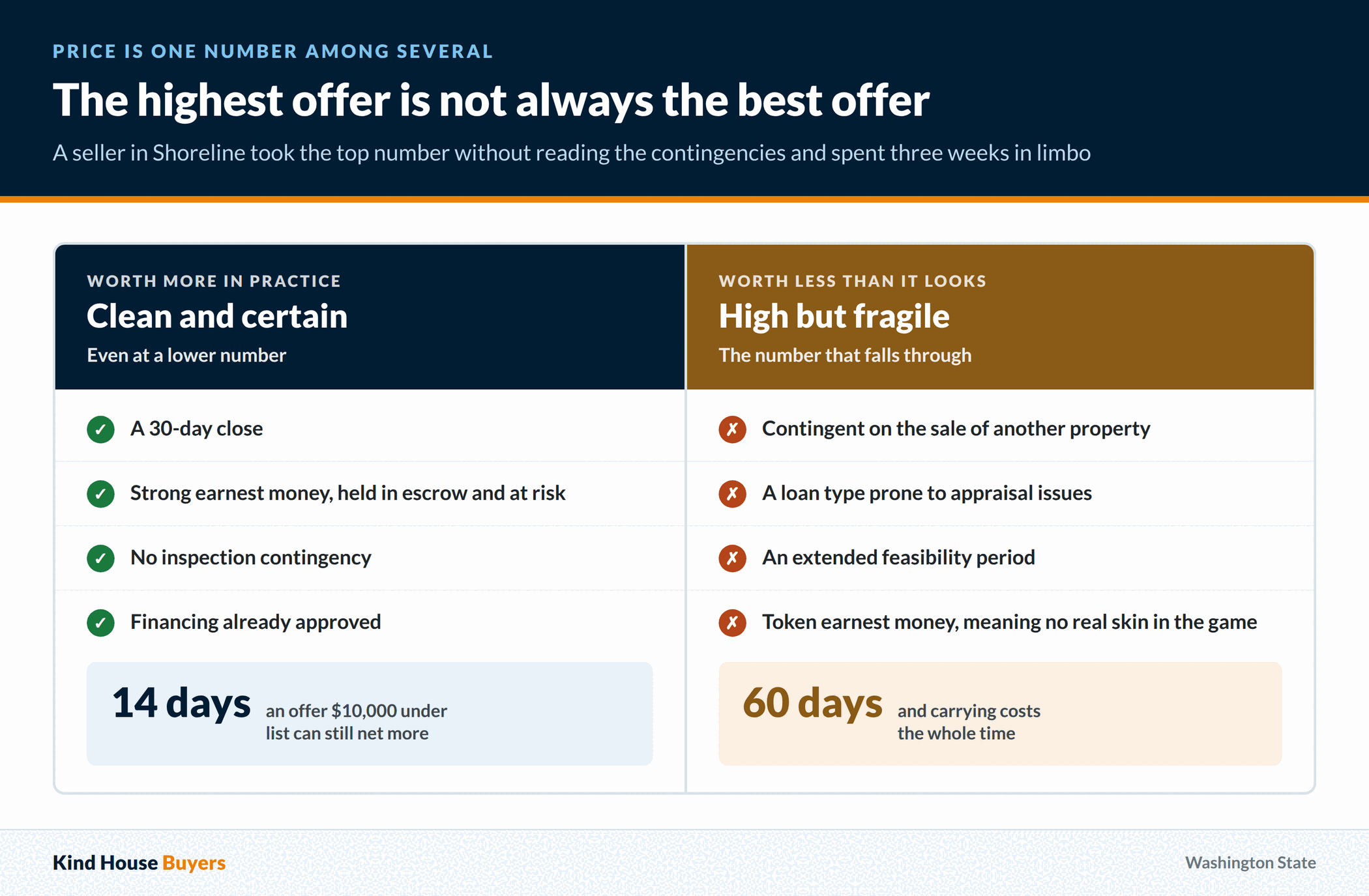
A seller in Shoreline accepted the highest offer on her house without reading the contingencies. Three weeks of limbo followed when the buyer’s financing fell through.
Price is one number among several. Consider an offer with a 30-day close, strong earnest money, no inspection contingency, and financing already approved. In practice it’s worth more than a higher offer contingent on the sale of another property, financed through a loan type prone to appraisal issues, and written with an extended feasibility period.
Read the financing type carefully. VA loans and FHA loans carry specific property condition requirements, which can create problems on homes that need work. Conventional loans give you more flexibility. Cash offers bypass the appraisal and close fastest; for a seller managing a relocation timeline, that speed has real value.
Earnest money tells you something about the buyer’s commitment. A buyer offering $500 earnest money on a $600,000 sale is not particularly invested. Solid earnest money is held in escrow and at risk if the buyer walks without a contingency excuse. That means skin in the game.
Ask for a closing date that lines up with your move. An offer at $10,000 below list that closes in 14 days may net you more than an offer at list price that closes in 60 days. Factor in carrying costs, insurance, and utilities on a home you’ve already left.
What Happens After You Accept an Offer on Your Washington State Home?
Once you’ve signed the purchase agreement, the clock starts on several parallel processes, and being out of state means you need to stay engaged even from a distance.
The buyer’s inspection period typically runs 10 to 15 days. If the home is being financed, the lender will order an appraisal, which can add another week or two to the timeline. Title is running simultaneously, searching for liens, easements, or any clouds on the property’s ownership history. Washington sellers are responsible for delivering clear title at closing, so if anything surfaces during the title search, it needs to be resolved before the escrow can close.
Your escrow company handles most of the heavy lifting, coordinating with the buyer’s lender, the title company, and both parties to prepare closing documents. You’ll sign your documents, remotely via a mobile notary if you’ve already relocated, and the funds get wired to you once both sides have signed and the county has recorded the deed.
Budget roughly 30 to 45 days from accepted offer to close on a financed sale. Cash sales move faster, sometimes closing in as little as 7 days or less, which is one of the biggest practical advantages for sellers managing a move.
What If You Need to Sell Your Current Home Before You Can Buy Another One?
For years, my default advice was to buy first and sell second if you could possibly afford it. I’ve walked that back. Carrying two mortgages while waiting for your Washington home to sell adds a financial pressure that changes how you evaluate offers and makes you less patient than you should be.
Selling first gives you a number you can rely on. You know your net proceeds, you know your buying power, and you’re not making decisions about your next home under deadline pressure. The tradeoff is that you might need temporary housing between closing and your next home, but short-term rentals in most markets are easier to find than sellers assume.
Bridge loans are an option if you genuinely need to buy before you sell. A bridge loan lets you tap your current home’s equity to fund the down payment on the next property. It pays off once your Washington home closes. Interest accrues on the bridge loan during the period both properties are open, and the fees add up faster than most borrowers expect. Get a clear breakdown from your lender before committing to that structure.
Sellers in strong equity positions, which describes most Washington homeowners given price appreciation over the last decade, have room to negotiate a rent-back agreement. You sell your home, collect the proceeds, rent it back from the new owner briefly, and finalize your next move. Buyers will sometimes agree to this, especially if they’re flexible on their move-in date.
How Do You Sell Your Washington State Home While Relocating Out of the Area?
Some sellers push back on the idea that selling from a distance is manageable. They’re picturing constant flights back to Bellevue, a house sitting empty and vulnerable, and a transaction falling apart because nobody was there to handle it. Those risks are real but solvable.
Power of attorney is one solution. A trusted family member or attorney can sign closing documents on your behalf. They can attend any meetings that require a Washington State presence and handle logistics while you settle into your new location. Your real estate attorney can prepare a limited power of attorney specific to the property sale.
Remote notarization is now accepted for many real estate documents in Washington, so you may not need to travel back at all for closing. Your escrow officer can confirm what’s possible for your specific transaction.
A property manager or trusted contact in Washington can handle showings, coordinate with your listing agent, and keep an eye on the home between appointments. If the house is vacant, a basic security system and regular check-ins prevent the small problems that become big ones over six weeks on market.
One pattern I keep seeing with out-of-area sellers: they underestimate how quickly a vacant home deteriorates. A dripping pipe in November, a broken window seal that lets moisture in, a furnace that goes out with the house sitting empty. Staying on top of the property remotely takes more effort than most people plan for.
That’s a big reason sellers relocating from Washington often find that a direct sale to a local buyer like Kind House Buyers makes practical sense. No showings to coordinate, no inspection negotiations to manage from two time zones away, and a closing timeline you control. An owner in Lacey I worked with had already started his new job in Colorado when he realized he couldn’t manage the listing process from there. He’d watched two agent listing attempts expire with zero offers over seven months, his carrying costs had eaten into his margin, and he just wanted it done. We closed in eleven days. His garage had a full woodworking setup he’d spent years building that he couldn’t take with him, and he left it. Sometimes the clean exit is worth more than the last few thousand dollars.
Frequently Asked Questions
Do I Have to Pay Capital Gains When I Sell My House in Washington State?
For most Washington State homeowners selling their primary residence, the IRS offers an exclusion. It covers the first $250,000 of profit for single filers, or $500,000 for married couples filing jointly. To qualify, you must have owned the home for at least two of the last five years before the sale. You must also have lived in it as your primary residence for at least two of those five years. On the state side, Washington’s capital gains excise tax has exemptions in place. Real estate, retirement accounts, and some other miscellaneous investments all sit outside it. Most primary residence sales won’t trigger Washington’s state capital gains tax either. If your gain exceeds the federal exclusion, or if the property was a rental or second home, consult a tax professional before closing.
What Is the Hardest Month to Sell a House?
January is consistently the slowest month for home sales in Washington State. Seasonality matters, as homes listed in spring and summer typically sell faster than those listed in fall and winter. That said, a well-priced home in a desirable neighborhood, whether in Olympia, Everett, or the Eastside suburbs, will find buyers year-round. If your relocation timeline forces a winter sale, don’t panic; just price accurately and make sure the home shows well in low winter light.
Can I Sell My House If I Live in Another State?
Yes, absolutely. You don’t have to be in Washington to sell your Washington property. Your escrow company can coordinate remote signing, many transactions close with a mobile notary, and a limited power of attorney lets a local representative handle anything that requires in-person presence. If the logistics feel unmanageable, selling to a direct buyer who handles everything without requiring showings and extended negotiations simplifies the process considerably.
How Do I Reduce or Avoid Capital Gains Tax When Selling My House?
The most reliable method for most homeowners is meeting the federal primary residence exclusion requirements described above. Beyond that, increasing your adjusted cost basis by documenting capital improvements (not routine repairs, but permanent improvements like additions, a new roof, or HVAC replacement) reduces the gain subject to tax. Transfer taxes paid are not deductible from your federal income tax but may be added to your cost basis for capital gains calculations. If you’re selling an investment property rather than a primary residence, a 1031 exchange lets you defer federal capital gains tax by rolling proceeds into a like-kind property, though it won’t avoid Washington’s REET. Talk to a CPA or real estate attorney early. The tax planning options narrow once you’ve already closed.
If you want to talk through your options, we’re here. Already in your new city, or still packing boxes in Tacoma? Reach out to Kind House Buyers and we’ll give you a straight answer about what your home is worth and what a direct sale would look like. No obligation, no pressure, just a real conversation about what makes sense for your situation.
Leaving Tacoma and Still Holding the House
Tacoma is our home market, and relocation calls are some of the most common we get. The typical Tacoma home value was $496,203 as of July 31, 2026, close to flat over the year. Flat means the house is not quietly earning back what you spend holding it. Every month you carry a mortgage on a place you no longer live in is a month you do not get back.
We buy across the region, including Lakewood, Auburn, Kent, Everett, and Puyallup. Our how it works page covers how a closing runs when the seller is already in another state.
Get the Number Before You Load the Truck
The best time to find out what your house is worth to a direct buyer is before you leave, not four months into paying two housing costs. Plenty of people run the comparison and decide to list, which is often the right answer when the house shows well and the timeline is loose. We will tell you when that is the case.
You can read common questions for Kind House Buyers first if you would rather. When you want a real number to plan the move around, contact us. No cost and no obligation, and distance is not a problem on our end. The short form below reaches us directly.